VA Appraisal vs. Home Inspection: What’s the Difference?
You're buying a home in San Antonio with a VA loan.
Your lender says:
“We're ordering the VA appraisal.”
And you think:
“Perfect. So that means the house is getting inspected.”
🚨 NOPE.
This is one of the biggest misunderstandings I hear from VA buyers.
The Department of Veterans Affairs says it very clearly:
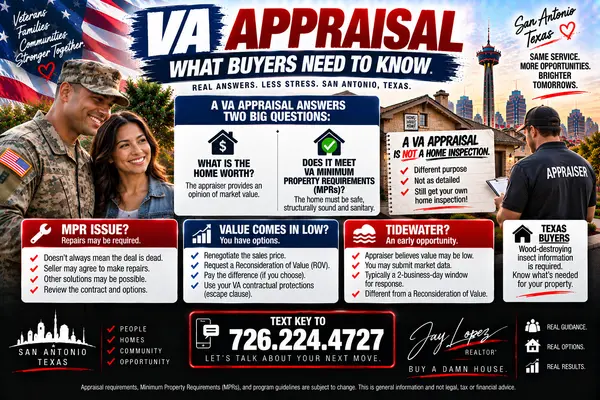
A VA APPRAISAL IS NOT A HOME INSPECTION.
VA strongly recommends that buyers get a separate home inspection to check for major defects before purchasing a home.
These are two different processes with two different purposes.
Let's make this really easy.
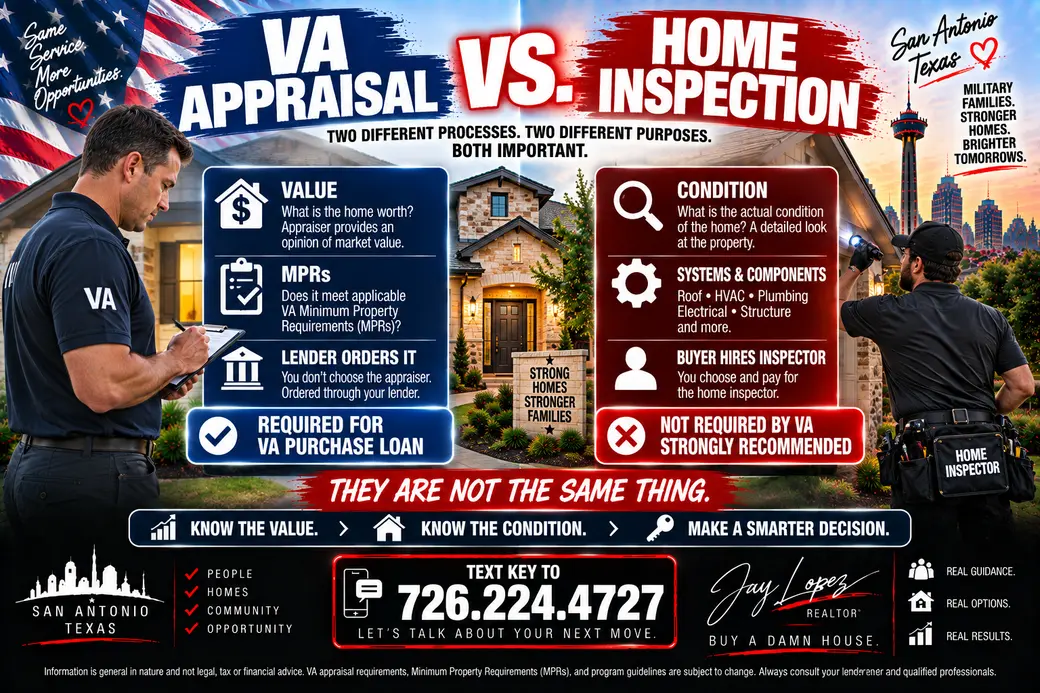
VA Appraisal vs. Home Inspection — The Quick Answer
| VA Appraisal | Home Inspection |
|---|---|
| Ordered through the lender | Buyer typically chooses/hire inspector |
| Provides an opinion of market value | Evaluates the home's condition |
| Addresses VA Minimum Property Requirements | Examines systems and components in greater detail |
| Required for a VA purchase loan | VA does not require one |
| Appraiser is not working as your home inspector | Inspector's job is to assess and report on condition |
| Does not guarantee the home's condition | Helps you understand defects and maintenance concerns |
VA's current guidance says the appraiser provides an opinion of value and determines whether the home meets applicable Minimum Property Requirements, while VA's buyer guide says an inspection can examine systems such as heating, cooling, plumbing, electrical and structural components.
YOU MAY WANT BOTH.
And here's why.
What Does the VA Appraisal Actually Do?
The VA appraisal is part of your VA financing process.
Once you're under contract, your lender requests a VA appraisal.
The VA-approved appraiser primarily addresses two questions:
💰 1. WHAT IS THE HOME WORTH?
The appraiser develops an opinion of the property's market value.
🏠 2. DOES IT MEET APPLICABLE VA MINIMUM PROPERTY REQUIREMENTS?
These are generally called:
MPRs
The lender uses the appraisal as part of determining whether the property and loan meet VA requirements.
What Doesn't the VA Appraisal Do?
This is where buyers get into trouble.
A VA appraisal does not mean:
The roof has been thoroughly inspected.
The HVAC has been fully tested.
The plumbing has been completely evaluated.
Every electrical component has been checked.
The foundation has received an engineering evaluation.
The house has been guaranteed defect-free.
VA specifically says an appraisal is not a home inspection or a guaranty of value, and VA does not guarantee the property's condition.
That's a major distinction.
Think of It This Way
Here's my simplest explanation:
🇺🇸 VA APPRAISAL
“Does the value support the transaction, and does the property meet applicable VA requirements?”
🔍 HOME INSPECTION
“What am I actually buying?”
That's not the technical definition.
😂
But it's a pretty good way to remember the difference.
What Does a Home Inspector Look At?
A home inspection is much more focused on the property's condition.
Depending on the property, inspection scope and applicable standards, an inspector may evaluate things such as:
Roof
Foundation and structure
Electrical system
Plumbing
Heating and cooling
Interior and exterior components
and other accessible systems and components.
VA's own buyer guide identifies heating, cooling, plumbing, electrical and structural components among the areas a home inspection can address.
The goal is to help you better understand:
WHAT CONDITION IS THIS HOUSE ACTUALLY IN?
Does VA Require a Home Inspection?
NO.
VA currently does not require a standard home inspection to obtain a VA home loan.
But VA strongly recommends that buyers obtain one.
That's worth paying attention to.
VA isn't saying:
“We already appraised it, so you're good.”
They're saying:
GET THE HOUSE INSPECTED.
Why Would I Need an Inspection If the VA Appraiser Looks at the Property?
Because they're performing different jobs.
The appraiser may identify readily observable conditions relevant to VA's Minimum Property Requirements.
But VA itself explains that the appraisal is not intended to replace a detailed inspection of the property.
Imagine buying a house because the appraisal met VA requirements.
Then after closing you discover:
HVAC needs replacement.
Water heater is near the end of its life.
Electrical repairs are needed.
There's a plumbing problem.
Roof repairs are coming.
Your response can't be:
“BUT THE VA APPRAISER LOOKED AT IT!”
That's not what the appraisal was designed to tell you.
What Are VA Minimum Property Requirements?
We covered this in Blog #33, but here's the quick version.
VA Minimum Property Requirements are property standards that apply to VA-backed loans.
The appraiser considers whether the property meets applicable MPRs as part of the appraisal.
VA updated its MPR guidance effective May 1, 2026, removing or revising some older requirements in an effort to reduce unnecessary delays and costs.
That's another reason to be careful with advice like:
“VA won't finance that house.”
The current rules matter—not something somebody remembers from years ago.
MPR Issue vs. Inspection Issue
Here's where it gets interesting.
Suppose your home inspector identifies an issue.
Does that automatically mean:
“THE HOUSE FAILS VA.”
No.
An inspection issue and a VA MPR issue aren't automatically the same thing.
A home inspection can identify maintenance concerns, defects or aging components that don't necessarily become VA appraisal requirements.
Likewise, an appraiser may identify an MPR-related condition that must be addressed for the financing to proceed.
Different process.
Different standard.
Different purpose.
Example: HVAC
Imagine the home's air-conditioning system is operating.
The property may not have an obvious MPR problem based solely on that fact.
But your inspector might tell you:
“This unit is old and showing signs of significant wear.”
That's information you probably want before buying the house.
Especially in:
SAN ANTONIO.
😂
August is not when you want to discover your AC was hanging on through sheer determination.
Example: Roof
Same idea.
An appraiser isn't performing the same roof evaluation as a qualified inspector or specialist.
Your inspector may identify:
Age
Visible deterioration
Damage
Potential leakage
or recommend further evaluation.
That information can influence what you do during your inspection and contractual due-diligence period.
Example: Foundation
San Antonio buyers know this one matters.
An inspector may observe signs that warrant further investigation and recommend evaluation by an appropriate specialist, such as a structural engineer.
VA's buyer guide specifically notes that a buyer may want to consider a structural engineer, particularly for an older property, when a more specialized structural assessment is appropriate.
Again:
THE APPRAISAL DOESN'T REPLACE THAT.
What Happens If the Home Inspection Finds Problems?
First:
DON'T PANIC.
Almost every resale house has something.
Sometimes it's minor.
Sometimes it's maintenance.
Sometimes it's something you want professionally evaluated.
Sometimes it's significant.
Your options depend on your purchase contract, deadlines, negotiated terms and circumstances.
Depending on those factors, buyers may potentially:
Request repairs
Request other negotiated concessions where permitted
Obtain specialist evaluations
Accept the property as-is
or exercise applicable contractual rights.
VA's buyer guidance also notes that inspection findings can give buyers information useful in negotiating with a seller.
For Texas buyers, your contract and deadlines matter tremendously.
Texas Option Period vs. VA Appraisal
This is another distinction San Antonio buyers need to understand.
Your Texas contract may provide a negotiated termination option with a specific deadline.
The VA appraisal operates on its own timeline as part of your financing.
Those clocks aren't necessarily the same.
So don't think:
“I'll wait for the VA appraisal before worrying about my inspection.”
Your contractual inspection and option-period strategy needs to follow your contract's deadlines.
That's one reason we want the inspection scheduled quickly after going under contract.
What Happens If the VA Appraisal Finds a Problem?
That's different.
If the appraisal identifies a condition that must be corrected for the property to satisfy applicable VA requirements, the lender may require that issue to be addressed before the loan can proceed.
The Notice of Value may identify repairs required to meet VA MPRs.
That becomes:
A FINANCING / PROPERTY-ELIGIBILITY ISSUE.
Not merely:
“The buyer doesn't like something.”
Who Pays for Repairs?
Don't assume:
“VA says repair, therefore seller pays.”
That's not how I want buyers thinking about it.
The parties still need to deal with the repair according to the contract, applicable VA/lender requirements and whatever agreements can be negotiated.
The seller may agree.
Another permissible solution may exist.
Or the parties may not reach an agreement.
VA DOESN'T MAGICALLY REWRITE YOUR CONTRACT.
What Happens If the Appraisal Comes in Low?
This is another place where the appraisal and inspection completely separate.
Suppose:
Purchase price: $375,000
VA appraised value:
$360,000
That's a valuation problem, not an inspection problem.
Current VA guidance identifies several potential options:
Request a Reconsideration of Value
Renegotiate the sales price
or
Pay the difference at closing.
Your VA escape clause may also provide important protection when the appraised value is below the contract price.
What If the Inspection Finds a $15,000 Problem?
Now we're dealing with something different.
Imagine the house appraises at:
$375,000
Great.
But your inspection identifies a potentially expensive issue requiring further evaluation.
The fact that:
VALUE = $375,000
doesn't mean:
CONDITION = PERFECT.
This is exactly why the two processes shouldn't be confused.
Can a House Pass the VA Appraisal and Still Have Problems?
YES.
VA explicitly says it doesn't guarantee the condition of the house.
That might be the most important sentence in this entire article.
A property meeting applicable VA appraisal requirements does not mean:
“Nothing will break.”
“There are no hidden defects.”
“Every system is in perfect condition.”
“You don't need an inspection.”
That's not what VA is telling you.
Can an Inspection Find Something the Appraiser Didn't?
ABSOLUTELY.
That's part of the reason you hire an inspector.
Inspectors spend their time evaluating the property's systems and components from a condition perspective.
The VA appraiser has a different assignment.
One isn't a substitute for the other.
What About New Construction?
Here's another myth:
“It's brand new. Why would I inspect it?”
Because:
NEW DOESN'T MEAN IMPOSSIBLE TO HAVE DEFECTS.
😂
Construction involves a lot of people, materials and moving pieces.
A new-construction home can still have:
Installation issues
Finish problems
Electrical concerns
Plumbing issues
HVAC concerns
or other items worth identifying before closing.
VA also maintains specific guidance for proposed and new construction properties.
Texas VA Buyers: Don't Forget Wood-Destroying Insects
Texas also has specific VA requirements concerning wood-destroying insect information.
That's separate again from thinking:
“My standard home inspection covers everything.”
Different inspections, reports or documentation may be required depending on the property and financing.
Your lender and Realtor should help identify what's needed for your specific transaction.
Which Comes First: Inspection or Appraisal?
They may be happening around the same time.
But from a buyer-strategy standpoint, I generally don't want to unnecessarily delay getting your home inspection scheduled.
Why?
Because your purchase contract has deadlines.
The lender controls the appraisal-order process.
Those are two separate timelines.
Once you're under contract:
THE CLOCK IS RUNNING.
The Easy Way to Remember All of This
Here's your cheat sheet:
🔍 HOME INSPECTION
“WHAT CONDITION IS THE HOUSE IN?”
Looks deeper at systems and components.
🇺🇸 VA APPRAISAL
“WHAT IS THE PROPERTY WORTH, AND DOES IT MEET APPLICABLE VA REQUIREMENTS?”
Provides an opinion of value and addresses MPRs.
Do I Really Need Both?
The VA appraisal is part of the VA purchase-loan process.
The home inspection isn't required by VA—but VA strongly recommends one.
For most buyers, I want you making a decision with as much useful information as reasonably possible.
You're not buying:
A couch.
A television.
A used lawn mower.
😂
You're buying a:
HOUSE.
Spending money to better understand what you're buying can be extremely valuable.
VA Buyer Checklist After Going Under Contract
📝 1. REVIEW YOUR CONTRACT DEADLINES
Know exactly when they expire.
🔍 2. SCHEDULE YOUR HOME INSPECTION
Don't confuse this with the appraisal.
🏦 3. LET YOUR LENDER ORDER THE VA APPRAISAL
The lender handles that process.
🛠️ 4. REVIEW INSPECTION FINDINGS
Determine whether additional evaluations may be appropriate.
💬 5. HANDLE ANY NEGOTIATIONS WITHIN YOUR CONTRACT
Don't miss deadlines.
🇺🇸 6. REVIEW ANY VA MPR ISSUES
These can affect financing.
💰 7. REVIEW THE APPRAISED VALUE
If it's low, understand your available options.
🔑 8. KEEP MOVING TOWARD CLOSING
The Bottom Line
Here's the sentence every VA buyer should remember:
🇺🇸 THE VA APPRAISAL IS NOT YOUR HOME INSPECTION.
The appraisal gives an opinion of value and evaluates applicable VA Minimum Property Requirements.
The home inspection gives you a much deeper look at the property's condition.
VA itself strongly recommends an inspection before you buy.
So don't skip valuable due diligence because somebody told you:
“VA already inspected the house.”
They didn't.
KNOW THE VALUE. KNOW THE CONDITION. KNOW WHAT YOU'RE BUYING.
Buying With VA in San Antonio?
I'll help you understand the process before we're standing in somebody's kitchen wondering what an MPR is.
😂
🔑 Text KEY to 726.224.4727
Send me:
Veteran / Active Duty
Your approximate price range
and
When you're planning to buy.
Example:
“KEY — Active Duty — around $325K — PCS in January.”
Follow @jaylopezrealtor for San Antonio VA home-buying education, PCS information, new construction and military real estate.
Buy a damn house. 🇺🇸🔑
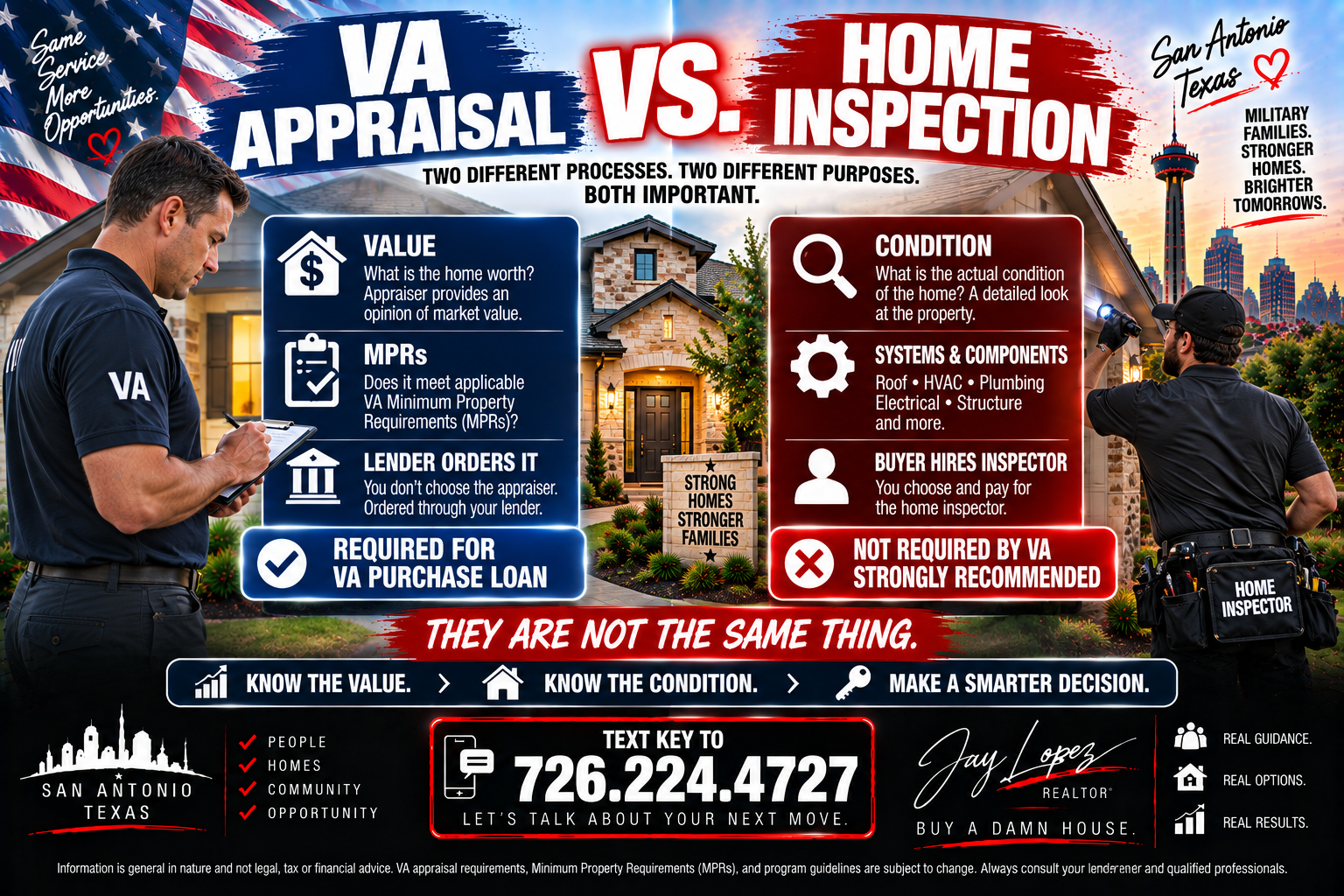
Featured Image Concept
Let's make this one a really clean VS graphic, so someone understands it in three seconds.
🇺🇸 VA APPRAISAL
VS.
🔍 HOME INSPECTION
Split screen.
LEFT — VA APPRAISAL
🏠 VALUE
What is the home worth?
✅ MPRs
Does it meet applicable VA requirements?
🏦 LENDER ORDERS IT
Large bottom label:
REQUIRED FOR VA PURCHASE LOAN
RIGHT — HOME INSPECTION
🔍 CONDITION
What am I actually buying?
🔧 SYSTEMS & COMPONENTS
Roof • HVAC • Plumbing • Electrical • Structure
👤 BUYER HIRES INSPECTOR
Large bottom label:
NOT REQUIRED BY VA — STRONGLY RECOMMENDED
Huge center banner:
🚨 THEY ARE NOT THE SAME THING
Background: San Antonio home in the middle, VA appraiser on the left and home inspector with flashlight/tool bag on the right. Subtle American flag and San Antonio skyline.
Bottom:
KNOW THE VALUE. KNOW THE CONDITION.
TEXT KEY — 726.224.4727
Jay Lopez | REALTOR®
Buy a damn house.
Categories
Recent Posts