VA Appraisals Explained: What Buyers Need to Know
Few parts of the VA home-buying process create more unnecessary anxiety than these two words:
VA APPRAISAL.
You may have heard:
“VA appraisers are ridiculously strict.”
“The house has to be perfect.”
“VA appraisals always come in low.”
“If anything is wrong with the house, VA won't finance it.”
or:
“You don't need an inspection because VA already inspects it.”
That last one especially needs to disappear.
😂
Because:
🇺🇸 A VA APPRAISAL IS NOT A HOME INSPECTION.
The VA appraisal has two important jobs: provide an opinion of the property's value and determine whether the property meets applicable VA Minimum Property Requirements, commonly called MPRs. VA itself specifically distinguishes the appraisal from a home inspection.
Let's break the process down without making it complicated.
What Is a VA Appraisal?
Once you're under contract on a home using VA financing, your lender requests an appraisal from a VA-approved appraiser.
The appraiser evaluates the property and develops an:
OPINION OF MARKET VALUE
The appraiser also considers whether the property meets VA's applicable:
MINIMUM PROPERTY REQUIREMENTS — MPRs
VA describes those standards as basic property-condition requirements for a VA-backed home loan.
So think:
VALUE + MPRs
Not:
COMPLETE HOME INSPECTION.
Why Does VA Require an Appraisal?
A VA-backed loan involves a guaranty from the Department of Veterans Affairs.
The lender needs adequate collateral for the mortgage, and VA has property requirements that must be satisfied.
The appraisal helps answer:
1. What is the property's market value?
and
2. Does the property satisfy applicable VA property requirements?
The lender reviews the completed appraisal as part of the loan process.
Who Chooses the VA Appraiser?
NOT THE BUYER.
And your Realtor doesn't get to call his favorite appraiser and say:
“Hey Bob, help us out.”
😂
The appraisal process is designed to maintain independence. VA's buyer guidance notes that borrowers aren't involved in selecting the appraiser.
That's important because the appraiser isn't there to represent:
The buyer
The seller
The Realtor
or
The lender's desired sales price.
They're there to develop an independent appraisal.
VA Appraisal vs. Home Inspection
If you remember only one section from this article, make it this one.
🚨 VA APPRAISAL ≠ HOME INSPECTION
VA itself strongly recommends that buyers obtain a home inspection to check for major defects.
Why?
Because an appraiser isn't performing the same detailed investigation as a home inspector.
A home inspection may take a much deeper look at things such as:
Electrical systems
Plumbing
HVAC
Roof
Foundation
Appliances
Attic
Water heater
Drainage
and other components.
An appraisal serves a different purpose.
So please don't say:
“VA looked at it, so I don't need an inspection.”
Those are two different tools.
What Are VA Minimum Property Requirements?
You'll hear the acronym:
MPR
a lot during a VA purchase.
VA's Minimum Property Requirements establish standards a property must satisfy before the loan can receive VA guaranty.
Historically, VA has described the purpose of MPRs as helping ensure properties are safe, structurally sound, and sanitary, while also addressing certain location and legal considerations.
And there's an important 2026 update here.
VA Updated Its Minimum Property Requirements in 2026
This is why relying on what somebody remembers from their VA purchase ten years ago can be dangerous.
VA updated Chapter 12 of its Lenders Handbook, with revised Minimum Property Requirements taking effect May 1, 2026. VA says the changes were intended to remove outdated requirements, reduce delays and unnecessary costs, and make the appraisal process more efficient.
So when somebody says:
“VA ALWAYS requires ______.”
My response is:
Let's check the current rule.
Not the rule from 2014.
Does a VA House Have to Be Perfect?
NO.
This myth causes buyers to eliminate perfectly reasonable homes.
Historically, VA appraisal guidance has specifically distinguished genuine MPR issues from cosmetic items, minor deferred maintenance, normal wear and tear, and inconsequential conditions.
So things like:
“I hate that paint color.”
or:
“Those kitchen cabinets are ugly.”
😂
aren't the same thing as a property-condition issue affecting VA requirements.
What Kinds of Issues Can Matter?
The answer depends on the property and current VA requirements, but appraisers are looking for readily observable conditions relevant to applicable MPRs.
That's why it's smart to look carefully at a property before writing the offer.
If we see something that looks like it could become a VA issue, I'd rather discuss it before we're halfway through the transaction.
Texas Buyers: Termite Requirements Matter
Here's one that's particularly relevant to us in San Antonio.
VA's current local requirements identify Texas as a state where wood-destroying insect information is required before issuance of the VA Notice of Value.
That doesn't mean:
“Every house has termites.”
😂
It means Texas buyers need to understand the applicable wood-destroying insect requirements as part of the VA transaction.
Your lender, Realtor and appropriate inspectors should coordinate what's required for the specific property.
What Happens If the Appraiser Finds an MPR Issue?
The appraisal may be made subject to required repairs or corrections.
That doesn't automatically mean:
DEAL DEAD.
It means the issue has to be addressed according to applicable VA and lender requirements before the transaction can proceed to VA guaranty.
Depending on the situation, the parties may need to determine:
What needs to be corrected
Who will handle it
Whether the seller agrees
and
How it affects the contract timeline.
Does the Seller Have to Make VA Repairs?
NOT AUTOMATICALLY.
This is a contract and negotiation issue.
VA may require a condition to be corrected for the property to qualify for the financing.
But that doesn't magically mean:
“The seller is legally required to fix everything.”
The seller's obligations depend on the contract and what the parties agree to.
Sometimes the seller agrees.
Sometimes another permitted solution may exist.
Sometimes the parties can't reach an agreement.
That's why we need to understand the property and the contract.
Can the Buyer Just Ignore the Required Repair?
If a condition has to be corrected for the property to satisfy applicable VA requirements, simply saying:
“I'm okay with it.”
doesn't necessarily solve the financing issue.
The buyer's willingness to accept a condition and VA/lender property requirements are different questions.
What Is the Notice of Value?
You'll also hear:
NOV — NOTICE OF VALUE
When the appraisal process is completed and reviewed, the VA process produces a Notice of Value.
VA buyer guidance explains that the NOV documents the property's estimated value and may identify items requiring repair to satisfy VA Minimum Property Requirements.
So:
COE = Certificate of Eligibility
MPR = Minimum Property Requirement
NOV = Notice of Value
Military home buying really does come with its own alphabet.
😂
What Happens If the VA Appraisal Comes in at the Contract Price?
Beautiful.
From a valuation standpoint, that's what we were hoping for.
Assuming the property satisfies applicable requirements and the rest of the loan is progressing normally, we continue toward closing.
But remember:
APPRAISED VALUE DOES NOT GUARANTEE CONDITION.
That's another reason the home inspection still matters.
What Happens If the VA Appraisal Comes in LOW?
Now we're at the part everybody worries about.
Imagine:
Contract price: $350,000
VA appraised value:
$335,000
That's a:
$15,000 GAP.
Does that automatically kill the deal?
NO.
VA currently identifies several possible paths when the property doesn't appraise high enough for the loan, including requesting a Reconsideration of Value, renegotiating the sales price, or the buyer paying the difference.
And VA-backed purchase financing is generally limited by the lower of the purchase price or appraised value for this purpose.
OPTION #1: Renegotiate the Price
The buyer may ask the seller to reduce the sales price.
Example:
Contract:
$350,000
Appraisal:
$335,000
Buyer asks seller:
“Will you reduce the price to $335,000?”
The seller can agree.
Or negotiate.
Or decline.
Nothing automatically forces the seller to accept the lower price.
OPTION #2: Buyer Pays the Difference
A buyer may decide to bring additional cash to cover some or all of the difference between the appraised value and contract price.
VA specifically identifies paying the difference as one option.
But don't hear that and think:
“VA requires me to pay the gap.”
No.
It's an option.
And before doing it, I'd want to have a serious conversation about whether paying above appraised value makes financial sense for you.
OPTION #3: Meet Somewhere in the Middle
Maybe the seller reduces the price.
Maybe the buyer brings some additional cash.
Maybe the parties find a negotiated middle ground.
Example:
Contract: $350,000
Appraisal: $335,000
Seller drops to:
$342,500
Buyer covers:
$7,500
Whether that makes sense depends entirely on the buyer, seller, financing and contract.
OPTION #4: Reconsideration of Value
Now we're getting into a very VA-specific process.
If the buyer believes the appraisal doesn't accurately reflect the property's value, a:
RECONSIDERATION OF VALUE — ROV
may be requested.
VA's current home-buying guidance says valid sales data may be provided through the lender in support of a reconsideration request.
This isn't:
“We don't like the number. Please make it higher.”
😂
You need relevant information supporting the requested reconsideration.
What Is Tidewater?
This is one of the coolest—and most misunderstood—parts of the VA appraisal process.
TIDEWATER
may occur before the appraisal is finalized when the appraiser believes the estimated market value may fall below the sales price.
The appraiser notifies the designated Tidewater point of contact, creating an opportunity to submit relevant market data before the appraisal is completed. Current VA appraiser training provides a 2-business-day window for the Tidewater point of contact to submit that market data.
Think of it as:
“I MAY HAVE A VALUE PROBLEM. SHOW ME WHAT I COULD BE MISSING.”
Tidewater Is NOT the Same as an ROV
This distinction is worth understanding.
TIDEWATER
Occurs during the appraisal process, before the appraisal is completed.
ROV
Comes after the appraisal/NOV process when the Veteran borrower seeks reconsideration of the value.
VA's current appraiser training specifically distinguishes the two processes.
Your Realtor Matters During Tidewater
This is where having good market information matters.
If Tidewater is invoked, we may need to quickly evaluate:
Comparable sales
Property features
Recent market activity
and other relevant market evidence.
And we don't have unlimited time.
That current two-business-day response window means:
MOVE.
Not:
“I'll look at comps sometime next week.”
😂
What Is the VA Escape Clause?
Another major VA buyer protection is commonly called the:
VA ESCAPE CLAUSE
or
VA AMENDATORY CLAUSE.
VA tells buyers to make sure the purchase agreement contains the applicable VA escape clause, which provides an option not to proceed with the purchase when the property's reasonable value is less than the contract price.
This is extremely important:
A LOW VA APPRAISAL DOESN'T AUTOMATICALLY MEAN YOU MUST PAY THE DIFFERENCE.
You may choose to.
But that's different.
Can You Still Buy Above the VA Appraised Value?
Potentially, yes.
VA specifically lists paying the difference between appraised value and sales price as an option when the appraisal is insufficient for the full purchase price.
But:
Just because you CAN doesn't mean you SHOULD.
Ask:
Why am I paying above appraised value?
How much cash will I have left afterward?
What are comparable properties doing?
How long do I expect to own this home?
That's a financial decision—not an emotional one.
Do VA Appraisals Always Come in Low?
NO.
There is no VA rule saying:
“Veteran buyer? Knock $20,000 off.”
😂
The appraiser develops an opinion of value based on the property and market evidence.
Sometimes value supports the contract.
Sometimes it doesn't.
The important thing is understanding what options exist if there's a disagreement.
Are VA Appraisals Harder Than Conventional Appraisals?
I wouldn't frame it that way.
A better way to think about it is:
THE PROGRAM HAS DIFFERENT REQUIREMENTS.
VA appraisal requirements include the MPR component because the property must satisfy applicable VA standards.
That's different from saying:
“VA is impossible.”
And the 2026 MPR updates are particularly important because VA has specifically been modernizing requirements to reduce unnecessary delays and costs.
How Long Does a VA Appraisal Take?
There's no single nationwide number I would promise you.
VA publishes appraisal timeliness requirements by state and locality, and actual transaction timing can depend on location, property type, appraiser availability and other circumstances.
So if somebody tells you:
“Every VA appraisal takes exactly seven days.”
No.
Ask your lender what the current expectation is for your property and location.
What About New Construction?
VA appraisals also apply to qualifying new-construction transactions.
The requirements can differ depending on whether you're buying:
A completed inventory home
New construction
Proposed construction
or a property being altered or repaired.
VA maintains separate appraisal training and guidance for proposed and new construction.
That's why VA buyers considering builders should involve a knowledgeable lender early.
VA Appraisal Checklist for San Antonio Buyers
Once you're under contract:
🇺🇸 1. LENDER ORDERS THE VA APPRAISAL
Don't wait unnecessarily.
🔍 2. GET YOUR OWN HOME INSPECTION
Appraisal ≠ inspection.
🐜 3. ADDRESS APPLICABLE TEXAS WOOD-DESTROYING INSECT REQUIREMENTS
Know what's required for the property.
🏠 4. WATCH FOR MPR ISSUES
If repairs are required, deal with them quickly.
📊 5. BE READY FOR TIDEWATER
If invoked, the response window is short.
📄 6. REVIEW THE NOTICE OF VALUE
Know the value and any required conditions.
💰 7. IF VALUE IS LOW, REVIEW YOUR OPTIONS
Renegotiate?
ROV?
Bring additional cash?
Or use applicable contractual/VA protections?
🔑 8. KEEP MOVING TOWARD CLOSING
The Biggest VA Appraisal Mistake
Want to know what I think it is?
BEING AFRAID OF IT BEFORE IT EVEN HAPPENS.
Veterans sometimes eliminate homes because somebody told them:
“VA won't approve that.”
Maybe.
Maybe not.
Let's determine what the current VA requirements actually say.
The same goes for sellers.
Don't automatically reject a VA buyer because you heard:
“VA appraisals are a nightmare.”
Understand the process instead.
The Bottom Line
A VA appraisal isn't designed to make buying a home impossible.
It's part of the VA financing process.
Remember these four things:
1. IT DETERMINES AN OPINION OF VALUE.
2. IT ADDRESSES VA MINIMUM PROPERTY REQUIREMENTS.
3. IT IS NOT A HOME INSPECTION.
4. A LOW APPRAISAL DOESN'T AUTOMATICALLY KILL THE DEAL.
VA buyers have potential paths including renegotiation, reconsideration of value, paying a difference if they choose, and applicable protections in the purchase agreement.
Know the process.
Then make your decision with actual information instead of VA-loan folklore.
Buying With VA in San Antonio?
Let's build the strategy before you start making offers.
🔑 Text KEY to 726.224.4727
Send me:
Veteran / Active Duty
Your approximate price range
and
When you're planning to buy.
Example:
“KEY — Veteran — around $350K — buying this winter.”
Follow @jaylopezrealtor for San Antonio VA home-buying education, PCS information, new construction and military real estate.
Buy a damn house. 🇺🇸🔑
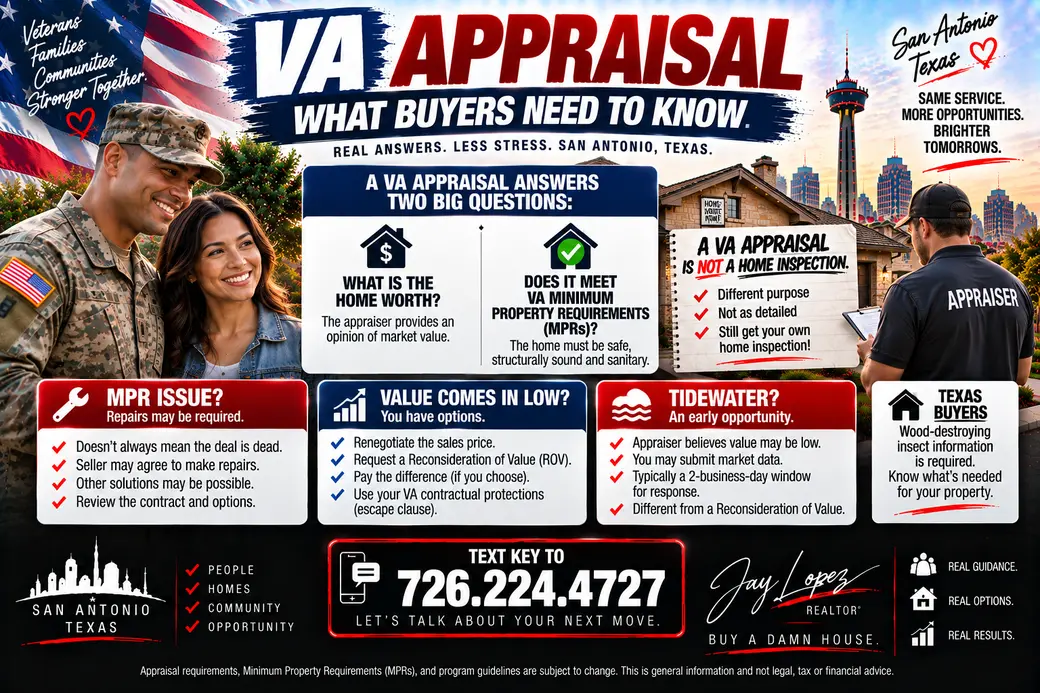
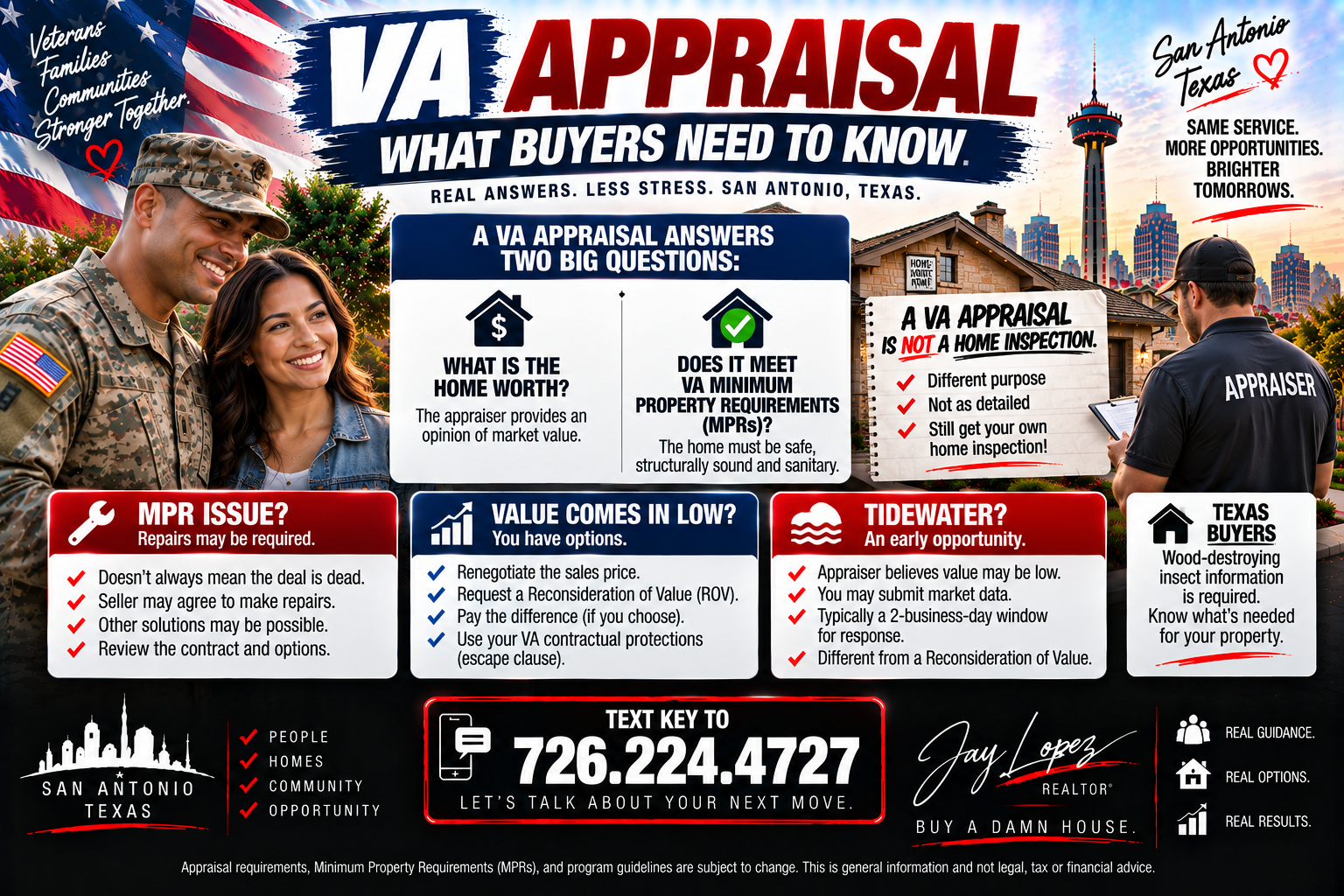
Featured Image Concept
This should be an “VA APPRAISAL — DON'T PANIC” infographic.
Main Headline:
🇺🇸 VA APPRAISAL
WHAT BUYERS NEED TO KNOW
Center graphic:
🏠 VA APPRAISAL = 2 BIG QUESTIONS
💰 WHAT IS THE HOME WORTH?
✅ DOES IT MEET APPLICABLE VA MPRs?
Then a huge red warning box:
APPRAISAL ≠ HOME INSPECTION
Three smaller panels:
🛠️ MPR ISSUE?
Repairs may be required
📉 VALUE LOW?
Renegotiate • ROV • Pay Difference • Review Your Options
🌊 TIDEWATER?
Market data may be submitted before value is finalized
Background: VA/military buyer standing with Realtor outside a San Antonio home while an appraiser works in the background; subtle flag and Tower of the Americas.
Bottom:
DON'T FEAR THE VA APPRAISAL. UNDERSTAND IT.
TEXT KEY — 726.224.4727
Jay Lopez | REALTOR®
Buy a damn house.
Categories
Recent Posts