7 Questions to Ask Before Making an Offer on a House


You found it.
The house.
Great kitchen. ✅
Enough bedrooms. ✅
Good location for your needs. ✅
Backyard for the dog. ✅
And now you're standing in the living room saying:
“Jay, LET'S MAKE AN OFFER.” 🔥
Perfect.
But before we start filling in numbers on a contract, I want to answer a few questions.
Because buying a house isn't just about finding one you love.
It's about putting together an offer you understand and are comfortable with.
Here are seven questions I want San Antonio home buyers thinking about before making an offer.
1. What Do Comparable Homes Tell Us About the Price?
The listing price is important.
But it's not the only number that matters.
Before deciding what you're willing to offer, we can look at relevant market information, including comparable properties when available.
We may consider:
Recent sales
Current competition
Property condition
Size
Location
Features
Lot
and other differences between properties.
The goal isn't to find another house that's perfectly identical.
That probably doesn't exist.
The goal is to better understand the market surrounding the property.
List Price Doesn't Automatically Equal Market Value
A seller can ask whatever price they choose.
That doesn't automatically mean:
The property will appraise for that amount.
It also doesn't automatically mean:
The house is overpriced.
The listing price is the seller's asking price.
We still need to evaluate the property and market information before deciding what you are comfortable offering.
2. How Much Competition Are We Facing?
This can change the strategy significantly.
Before making an offer, we may try to understand:
How long has the property been listed?
Has the seller received other offers?
Is there an offer deadline?
Have there been price changes?
Has the property previously gone under contract, if that information is available?
A house that has been sitting on the market may call for a different conversation than one receiving significant buyer interest shortly after listing.
But don't automatically assume:
Multiple offers = offer anything necessary.
You still need boundaries.
Know Your Walk-Away Number
Before negotiations become emotional, decide what you're comfortable with.
Ask yourself:
“At what point would I rather lose this house than accept these terms?”
That's a powerful question.
Because once buyers fall in love with a house, it's easy to start saying:
“It's only another $5,000.”
Then:
“What's another $5,000?”
And suddenly the offer looks nothing like the original plan.
Have boundaries.
3. What Do We Know About the Condition of the Property?
We're not performing a home inspection before making every offer.
But we should consider the information currently available.
That may include:
Seller disclosures
Visible property condition
Age of major components when known
Previous repairs
Listing information
and other available documentation.
Maybe the house looks fantastic.
Maybe it obviously needs work.
Either way, condition can influence your offer strategy.
Don't Let Cosmetic Improvements Distract You
Fresh paint can make a home look amazing.
So can:
New flooring
Modern light fixtures
Staging
New cabinet hardware
and a beautiful backsplash.
But those aren't the only things we're buying.
We're also buying the:
Roof
HVAC
Plumbing
Electrical systems
Foundation
Windows
and everything else attached to the property.
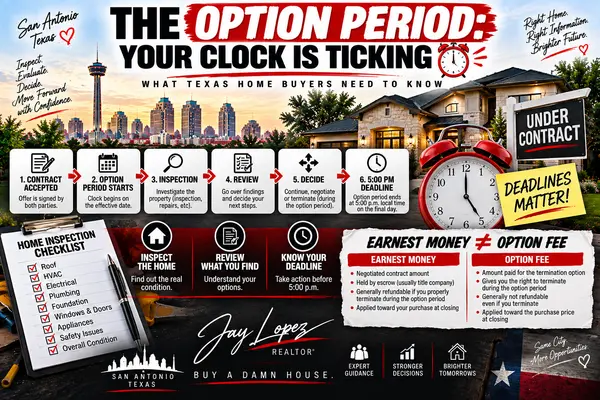
That's why the inspection process can be so important after you're under contract.
4. What Will the TOTAL Monthly Payment Look Like?
Please don't make an offer based only on:
“The house costs $350,000.”
We need to think about the monthly housing cost too.
Depending on your financing and property, that may include:
Principal
Interest
Property taxes
Homeowners insurance
Mortgage insurance, if applicable
HOA costs
and potentially other property-specific expenses.
Two houses with the same purchase price don't necessarily produce the same monthly cost.
Property Taxes Matter in San Antonio
Tax obligations can vary between properties and taxing jurisdictions.
So before making an offer, make sure the estimated payment uses reasonable property-specific information.
This can be especially important with new construction, where historical tax figures shown online may not reflect the taxes associated with the completed home.
Your lender can help estimate the payment.
5. Is There an HOA, and What Do We Know About It?
If the property belongs to a homeowners association, don't treat the HOA as an afterthought.
You may eventually receive and review applicable documents that contain information about things such as:
Assessments
Restrictions
Rules
Architectural requirements
and other matters affecting ownership.
If there's something especially important to you—maybe you plan to make a particular exterior modification, for example—don't simply assume it will be permitted.
Ask questions.
Review the applicable documents when provided.
6. What Terms Matter Besides the Price?
This is where buyers sometimes get surprised.
They think an offer is:
“I'll pay $350,000.”
But a Texas real estate offer contains much more than a purchase price.
Depending on the transaction, terms may address:
Financing
Earnest money
Termination option
Closing date
Seller contributions
Title matters
Possession
Included or excluded items
Addenda
and other negotiated provisions.
Price is only one piece of the offer.
Example: Two $350,000 Offers
Imagine a seller receives two offers.
Both say:
$350,000
Does that mean they're identical?
No.
The other contractual terms could be different.
That's why sellers typically evaluate the entire offer, not just the number at the top.
And that's why our job is to think about the entire package we're presenting.
7. What Happens If Something Goes Wrong?
This may be the most important question.
Before signing an offer, understand the important provisions and deadlines that may apply if circumstances change.
What if:
The inspection identifies a concern?
The appraisal comes in below the contract price?
Your financing encounters a problem?
There's a title issue?
HOA information reveals something important?
The answer isn't:
“Don't worry. You can always cancel.”
That's far too simplistic.
Your rights and obligations depend on the contract, addenda, negotiated terms, circumstances and deadlines.
Understand the Contract Before You Sign It
Don't wait until something goes wrong to ask:
“Wait...what does this section mean?”
Ask before you sign.
Your Realtor can explain the transaction and real estate contract provisions within the scope of their role.
If a legal question arises that requires legal advice, an attorney may be appropriate.
The goal is simple:
Know what you're agreeing to.
BONUS QUESTION: What Is Most Important to the Seller?
This isn't always information we'll know.
But when appropriate, communication between the agents may help us understand whether the seller has priorities beyond price.
For example, a seller might care about:
Closing timing
Possession
or other transaction terms.
That doesn't mean we automatically give the seller everything they want.
It means we can use available information when structuring the offer.
A Strong Offer Doesn't Always Mean the Highest Price
Buyers often ask:
“How do we make the strongest offer?”
There isn't one universal answer.
A competitive offer may involve a combination of terms that fit both the buyer's objectives and the transaction.
The goal isn't:
WIN AT ANY COST.
The goal is:
Put together an offer you're comfortable signing.
Because if the seller says yes...
You're potentially buying the house.
Don't Negotiate Against Yourself
Another common mistake?
Getting nervous before the seller has even responded.
Buyer:
“Let's offer $340,000.”
Five minutes later:
“Maybe we should do $345,000.”
Ten minutes later:
“What if someone else offers $350,000?”
We haven't even submitted it yet. 😂
Slow down.
Look at the information.
Choose the terms.
Submit the offer.
Then respond to what actually happens.
What If the Seller Rejects Your Offer?
A seller may:
Accept
Reject
or
Counter
an offer.
A rejection isn't the end of civilization.
And a counteroffer isn't automatically bad news.
It's negotiation.
You then decide whether the revised terms work for you.
Sometimes we reach an agreement.
Sometimes we don't.
There will be other houses.
That's worth remembering when emotions start taking over.
What If the Seller Accepts?
Now things get real. 🔥
Once the parties have entered into a binding contract, important deadlines can begin.
That's when we start tracking things such as:
Earnest money
Option fee
Inspections
Financing
Appraisal
Title
and other contractual obligations.
This is exactly why you want to understand the offer before it becomes the contract.
My 7-Question Offer Checklist
Before you make an offer, let's answer:
1. What does the market information tell us about price?
2. What do we know about competition?
3. What do we know about the property's condition?
4. What could the total monthly payment look like?
5. What do we know about the HOA?
6. Which contract terms matter besides price?
7. What rights, obligations and deadlines should you understand?
If we can answer those questions?
Now we're not just throwing a number at a house.
We're building an offer.
Found a House You Want to Buy?
Don't just hit:
“Contact Agent”
on five different websites. 😂
Let's look at the property, evaluate the information available and talk through your options.
🔑 Text KEY to 726.224.4727
Send me:
The property address
or
A link to the house.
I'll help you figure out the next step.
Follow @jaylopezrealtor for San Antonio homes, new construction, VA information, first-time buyer education and real estate tips.
Buy a damn house.
Categories
Recent Posts