What Are Closing Costs When Buying a Home in Texas?

You saved for the down payment.
You're pre-approved.
You found the house.
You're feeling pretty good.
Then somebody says:
“Don't forget about closing costs.”
And you're thinking:
“Wait...I need MORE money?” 😂
Possibly.
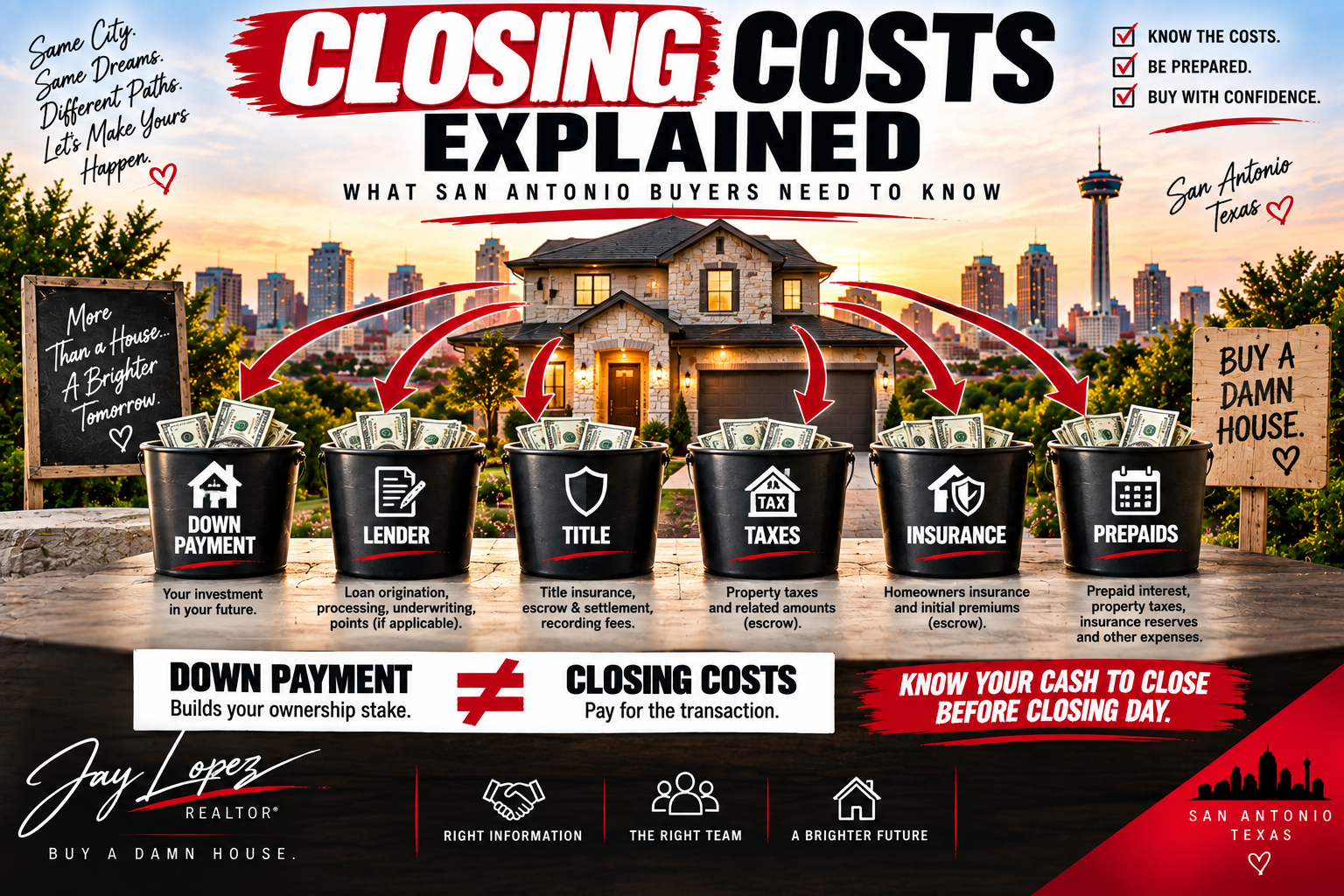
One of the biggest surprises for first-time home buyers is discovering that the down payment and closing costs aren't the same thing.
There can be several expenses involved in getting from an accepted offer to receiving the keys.
So if you're buying a home in San Antonio—or anywhere in Texas—let's break down closing costs without making it unnecessarily complicated.
1. What Are Closing Costs?
“Closing costs” is a broad term for various expenses associated with completing a real estate and mortgage transaction.
Depending on the transaction, costs may involve your:
Lender
Title company
Insurance
Taxes
Government recording
Appraisal
and other services or requirements.
The exact expenses depend on your financing, property and transaction.
That's why I don't like telling buyers:
“Closing costs are always exactly X%.”
Online percentages can be useful for rough planning, but your actual numbers matter more.
2. Your Down Payment Is Different
Let's clear this up immediately.
Imagine you're purchasing a:
$300,000 home
and your financing requires a hypothetical:
5% down payment
Your down payment would be:
$15,000
But that doesn't automatically mean $15,000 is the only money associated with buying the property.
You may have other closing and transaction expenses.
That's why in Blog #2, we talked about looking at your total cash requirement, not just the down payment.
3. What Kinds of Costs Could You See?
Your exact closing disclosure will depend on your transaction, but expenses can potentially include categories such as:
- Loan-related charges
- Appraisal-related costs
- Credit-report or verification-related charges
- Title and settlement charges
- Recording fees
- Homeowners insurance
- Prepaid interest
- Property-tax related amounts
- Escrow funding
- Other applicable expenses
Not every buyer will have the exact same list.
And not every charge is technically a “fee” in the sense of paying someone for a service.
Some amounts are prepayments or reserves for expenses you'll owe as a homeowner.
4. Lender Costs
If you're financing your purchase, your lender may have charges associated with originating and processing the mortgage.
These vary by lender and loan.
Depending on the financing, you might encounter costs related to loan origination, underwriting, processing, discount points or other lending services.
This is one reason comparing lenders can involve more than asking:
“What's your interest rate?”
A lower advertised rate doesn't automatically mean the lowest overall financing cost.
Ask about:
Rate
Loan costs
Points
Estimated cash to close
and
Monthly payment
Then compare the overall picture.
5. What Are Discount Points?
Depending on the mortgage, a borrower may have the option to pay discount points to obtain a different interest rate.
In simplified terms, you're paying additional money upfront in exchange for particular loan pricing.
Does that make sense?
Maybe.
Maybe not.
It can depend on:
How much the points cost
How much the rate changes
How much the monthly payment changes
How long you expect to keep the mortgage
Don't buy points simply because somebody tells you:
“Lower rate = better.”
Ask your lender to show you the numbers.
6. The Appraisal
For many financed purchases, the lender requires an appraisal.
The appraisal helps the lender evaluate the property's value for the mortgage transaction.
The appraisal cost may be collected before closing or otherwise reflected in your transaction depending on the lender's process.
Remember:
Appraisal = primarily value for lending purposes
Inspection = primarily property condition
They're different services.
7. Title-Related Costs
The title company plays an important role in a Texas real estate transaction.
Depending on the transaction, title-related expenses can involve matters such as:
Title insurance
Escrow and settlement services
Document preparation or other applicable services
Recording
and other closing-related items.
Who pays particular expenses can depend on the contract, transaction and applicable rules.
Your title company and Realtor can explain the specific charges that apply to your purchase.
8. What Is Title Insurance?
Title insurance is different from homeowners insurance.
Title insurance addresses certain risks involving ownership and title to real property, subject to the policy's terms, conditions and exclusions.
In Texas, you may encounter:
An owner's title insurance policy
and, when financing is involved:
A lender's title insurance policy
These policies protect different interests.
The contract and transaction determine how title-related expenses are handled.
If you're confused when you receive the title commitment or closing documents:
Ask questions.
You should understand what you're purchasing and signing.
9. Homeowners Insurance
If you're obtaining a mortgage, your lender will generally require homeowners insurance.
Your insurance premium depends on the property, coverage, insurer and other factors.
This is another reason I recommend buyers begin getting insurance quotes before the day before closing.
Insurance doesn't just affect your cash needed.
It can also affect your ongoing monthly housing expense if the premium is paid through escrow.
10. Property Taxes
Property taxes are especially important when you're buying around San Antonio.
Taxes can vary based on the property and applicable taxing jurisdictions, exemptions and other factors.
At closing, you may see amounts associated with property taxes depending on the timing and structure of the transaction.
Your lender may also establish an escrow account to collect funds toward future property-tax obligations.
Don't assume two similarly priced homes will have identical tax costs.
They may not.
11. What Is an Escrow Account?
For many financed purchases, the lender may establish an escrow account.
Part of your monthly payment may then be collected toward expenses such as:
Property taxes
and
Homeowners insurance
The lender holds those funds and pays applicable bills when due under the escrow arrangement.
At closing, the lender may require an initial amount to establish that account.
That's one reason your cash-to-close figure may contain money that isn't simply a lender or title-company “fee.”
12. What Is Prepaid Interest?
Mortgage interest can involve a prepaid amount covering the applicable period between closing and the beginning of your regular payment cycle.
The amount can depend partly on your closing date and loan.
Again, this isn't necessarily somebody charging you a random fee.
It's part of how the mortgage transaction is accounted for.
Your lender can show you the actual amount for your loan.
13. What About Earnest Money?
Earnest money deserves special attention because buyers often wonder:
“Do I lose that money at closing?”
Earnest money delivered under your contract isn't simply an extra charge added on top of everything else.
When the transaction closes, earnest money is generally credited as part of the settlement according to the contract and closing statement.
Exactly how the funds are applied depends on the transaction.
This is another reason to look at your final cash-to-close number, not add every amount you've paid during the transaction together as if they're all separate fees.
14. What About the Option Fee?
If your Texas contract includes a termination option, the agreed option fee is another amount buyers should plan for.
The option period can provide an unrestricted right to terminate during the negotiated period, subject to the contract's terms.
Just like earnest money, option money is governed by the contract.
Your Realtor should explain:
How much
Where it goes
When it's due
and
How it's treated at closing
before you sign the contract.
15. Can the Seller Pay Some of My Closing Costs?
Potentially.
Depending on the loan program, contract, negotiations and applicable limitations, the buyer and seller may negotiate seller contributions toward certain buyer expenses.
This can sometimes be particularly valuable to a buyer who has enough income to comfortably afford the monthly payment but wants to preserve cash.
However:
Seller contributions aren't automatic.
The seller has to agree.
And financing rules may limit which expenses and amounts can be paid.
Your Realtor and lender should coordinate when you're considering this type of offer structure.
16. Can a Builder Help With Closing Costs?
Sometimes new-home builders offer incentives involving closing costs.
This is one reason new construction can be worth comparing with resale homes.
A builder promotion might advertise something like:
Closing-cost assistance
or
Financing incentives when using a preferred lender
But incentives change frequently and may have conditions.
They can be limited by:
Community
Property
Loan program
Preferred lender
Closing deadline
Buyer qualification
or other requirements.
Never assume an advertisement applies to every house.
Ask for the details.
17. What About VA Buyers? 🇺🇸
VA-backed financing has specific rules involving allowable charges, fees and seller concessions.
Eligible VA borrowers may also be able to purchase without a down payment when applicable requirements are satisfied.
But remember something we've discussed before:
$0 down doesn't necessarily mean $0 out of pocket.
VA buyers can still have transaction expenses.
Some eligible Veterans may be exempt from the VA funding fee, while others may have a funding fee based on applicable VA rules.
A knowledgeable VA lender can provide the numbers for your specific transaction.
18. How Much Should I Budget for Closing Costs?
You're probably waiting for me to finally say:
“Exactly $____.”
I'm not going to. 😂
Because without knowing:
Your purchase price
Loan program
Interest-rate structure
Lender
Insurance
Property
Taxes
Contract terms
Seller contributions
Builder incentives
and other transaction details, an exact number would be misleading.
Use estimates for planning.
Use your lender's Loan Estimate and later Closing Disclosure for the transaction-specific numbers.
19. What Is a Loan Estimate?
For many mortgage transactions, federal rules require lenders to provide a Loan Estimate after receiving the information that constitutes an application under applicable regulations.
The Loan Estimate gives you important information about the proposed mortgage, including estimated:
Loan terms
Payments
Closing costs
and other information.
Read it.
Don't just look at the interest rate.
If something doesn't make sense:
Ask.
20. What Is the Closing Disclosure?
Later in the mortgage process, you'll generally receive a Closing Disclosure for covered transactions.
This document provides final or near-final details about your mortgage and closing costs.
Compare it with what you've been expecting.
Look at:
Loan amount
Interest rate
Monthly payment information
Closing costs
Credits
Cash to close
and other important terms.
If you see something you don't understand:
Don't be afraid to ask before signing.
It's your money.
21. Beware of Wire Fraud
This deserves its own section because it's that important.
Real estate transactions can involve significant wire transfers.
Criminals sometimes attempt to impersonate title companies, agents or other parties and send fraudulent wiring instructions.
If you receive an email saying:
“Our wiring instructions changed. Send your money here instead.”
STOP.
Do not rely solely on an email.
Verify wiring instructions directly with the title company using a known, trusted phone number or other verified method.
Never send money because somebody created an email that looks legitimate.
22. Your Cash to Close Is the Number We Really Need
When we're getting close to closing day, the number buyers care about most is:
Cash to close.
This reflects the applicable amounts due after accounting for items such as the down payment, closing costs, credits, deposits and other transaction figures shown in the settlement documents.
That's why:
Down payment ≠ automatically cash to close.
Understanding this distinction early can prevent a nasty surprise later.
Don't Let Closing Costs Surprise You
Closing costs shouldn't be something you first discover three days before buying the house.
When we're building your home-buying plan, I want you thinking about:
Down payment
Closing costs
Inspections
Cash reserves
and
Monthly payment
from the beginning.
Maybe seller contributions are possible.
Maybe a builder has a current incentive.
Maybe your financing gives us different options.
Maybe you simply need a little more time to save.
Let's find out before you fall in love with the house.
🔑 Text KEY to 726.224.4727
Tell me:
“I want to know how much money I'd need to buy.”
We'll start building the numbers.
Follow @jaylopezrealtor for San Antonio homes, new construction, VA information, first-time buyer education and real estate tips.
Buy a damn house.
Categories
Recent Posts