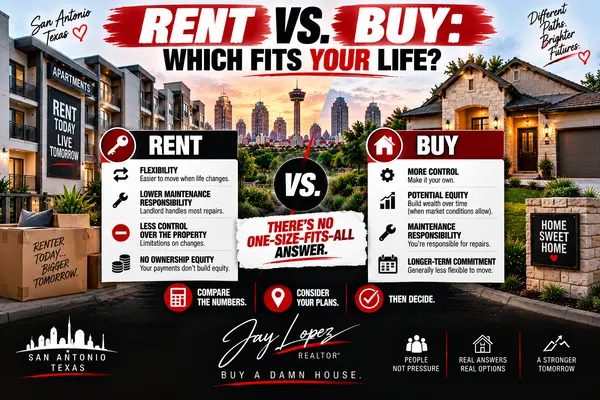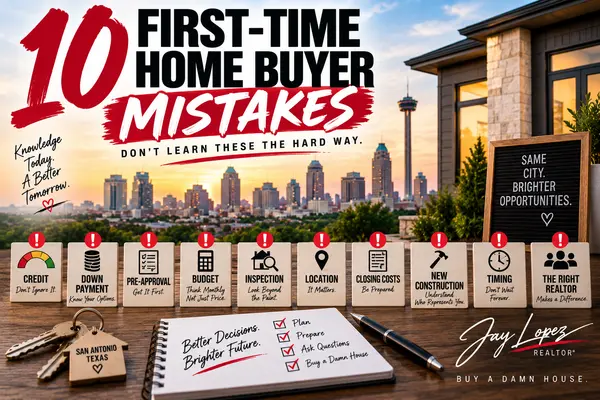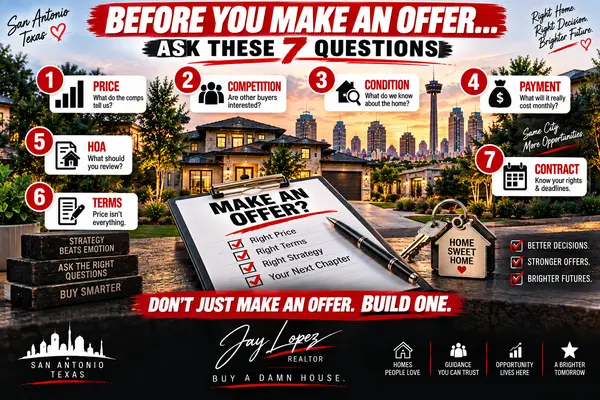
Can I Buy a House in San Antonio With a Low Down Payment?
One of the fastest ways to convince yourself you can't buy a house is to do this:
Find a $350,000 house.
Calculate 20%.
See $70,000.
Close Zillow.
Go back to renting. 😂
There's just one problem.
You don't necessarily need 20% down to buy a house.
Depending on your financial situation, eligibility, property, lender and loan program, you may have options that require significantly less.
And for some qualified buyers, a zero-down-payment option may even be available.
So if the down payment is the main thing keeping you from exploring homeownership in San Antonio, let's clear up some of the confusion.
1. Where Did the 20% Down Rule Come From?
Twenty percent down isn't imaginary.
There can be benefits to making a larger down payment.
For example, putting more money down generally reduces the amount you're borrowing. Depending on the financing, it may also affect mortgage insurance, loan pricing, monthly payments and other aspects of the loan.
But somewhere along the way:
“20% can have advantages”
turned into:
“Everybody needs 20% to buy a house.”
That's simply not the case for many mortgage programs.
Instead of asking:
“Do I have 20%?”
Start by asking:
“Which financing options might I qualify for?”
That's a much better conversation.
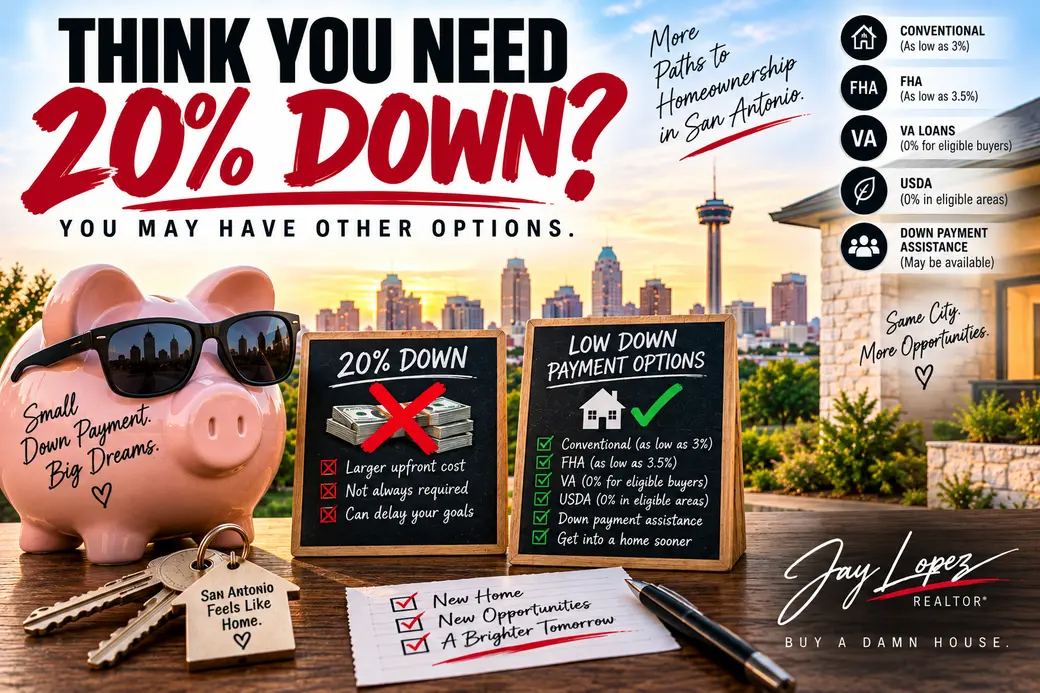
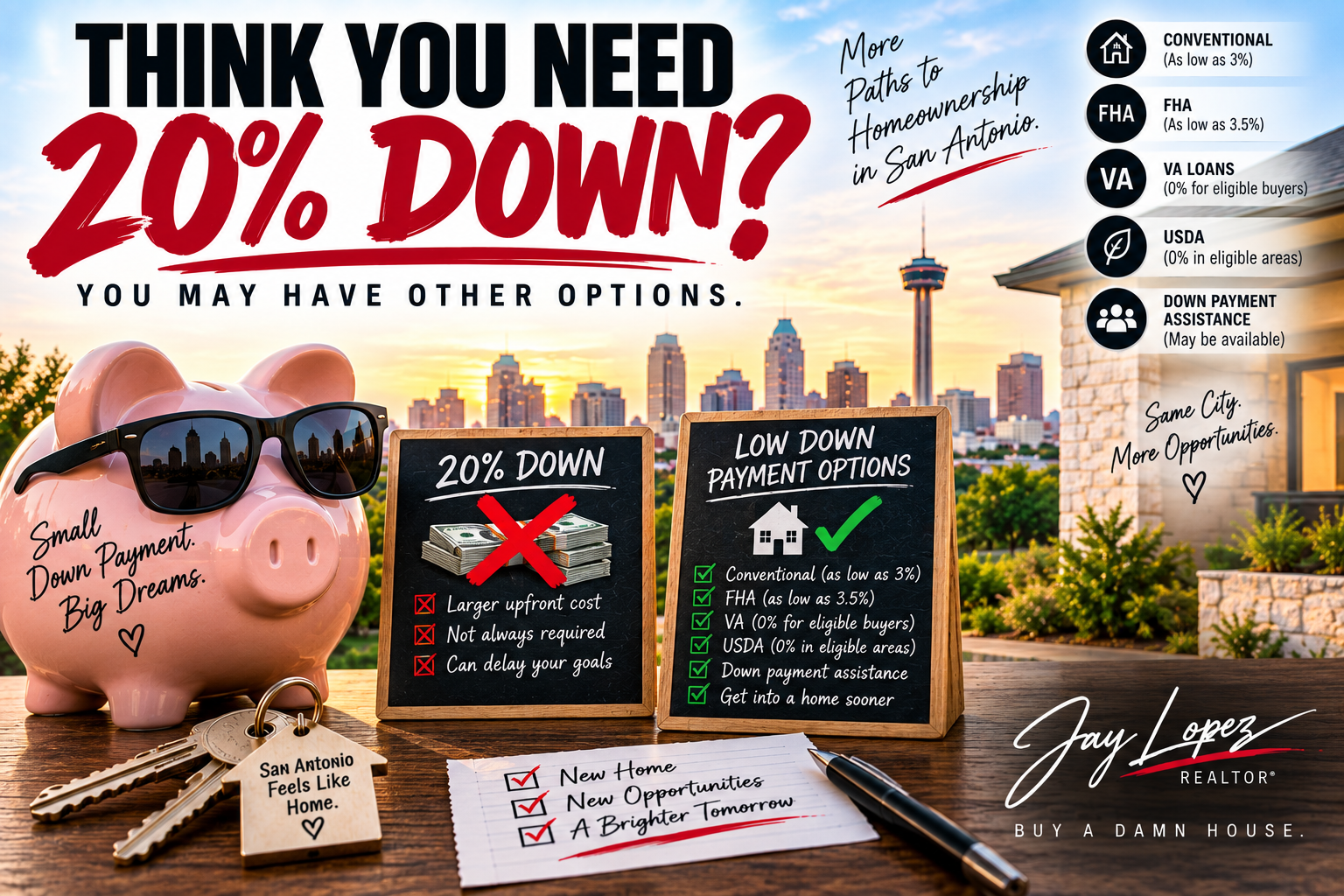
2. Conventional Loans May Offer Lower Down-Payment Options
Conventional financing doesn't automatically mean 20% down.
Depending on the loan program and borrower qualifications, certain conventional mortgage programs may permit much smaller down payments.
For some qualified borrowers and programs, that can be as little as 3% down.
That means a buyer considering a $300,000 property shouldn't automatically assume they'll need $60,000 for the down payment.
Three percent of $300,000, for example, is:
$9,000.
That's a very different number.
However, your down payment isn't necessarily your total cash requirement, and lower-down-payment conventional financing can involve mortgage insurance and other considerations.
A lender can show you how the available options affect your actual payment and cash needed.
3. FHA Loans Can Be Another Low-Down-Payment Option
FHA-insured financing is another program frequently considered by buyers who don't plan to make a large down payment.
Qualified borrowers may be able to purchase with a down payment as low as 3.5%, subject to FHA and lender requirements.
For example:
A 3.5% down payment on a $300,000 home would be approximately:
$10,500.
Again, that doesn't mean $10,500 is necessarily all the money you'd need for the entire transaction.
But it's nowhere near the $60,000 someone might assume they need after calculating 20%.
FHA financing also has mortgage insurance and other requirements that should be discussed with your lender.
4. VA Buyers May Have a $0-Down Option 🇺🇸
This is especially important here in San Antonio.
With Joint Base San Antonio, including Lackland, Randolph and Fort Sam Houston, we work with a lot of military families and Veterans.
Eligible VA borrowers with sufficient entitlement may be able to use a VA-backed purchase loan to finance 100% of the home's purchase price, subject to VA, lender and property requirements.
In other words:
A down payment may not be required.
That's one of the most powerful benefits available through the VA home loan program.
But let's make something very clear:
$0 down does NOT necessarily mean $0 out of pocket.
There can still be expenses associated with the transaction, including closing costs, prepaid expenses, inspections and other costs.
Some eligible Veterans may also be exempt from the VA funding fee.
Your lender can determine how the VA program applies to your specific circumstances.
5. USDA Financing May Also Offer a Zero-Down Option
Another program buyers sometimes overlook is USDA financing.
USDA loans may offer 100% financing to eligible borrowers purchasing qualifying properties in eligible areas.
There are geographic, household-income, property and other program requirements.
And no, USDA doesn't automatically mean you're buying a farmhouse surrounded by cows. 😂
Some properties outside major urban areas may fall within eligible locations.
For buyers willing to consider communities beyond central San Antonio, it's a financing option worth asking a qualified lender about.
6. What About Down-Payment Assistance?
Depending on your circumstances, there may also be homebuyer or down-payment assistance programs available through state, local or other approved programs.
These programs can have requirements involving things such as:
- Income
- Purchase price
- Occupancy
- Property eligibility
- Homebuyer education
- Financing
- Credit
- Program funding
Some programs may involve grants, deferred loans, forgivable assistance or other structures.
The details matter.
I wouldn't recommend choosing a house or financing strategy because somebody on social media told you there's “free money for home buyers.”
Find out what programs are actually available and whether you qualify.
7. A Smaller Down Payment Isn't Automatically the Best Choice
Here's where we need to be careful.
Just because you're allowed to put less money down doesn't automatically mean you should.
A larger down payment may result in a smaller loan amount and could affect your monthly payment, mortgage insurance and other loan costs.
On the other hand, putting every dollar you have into your down payment could leave you without adequate reserves after closing.
Remember:
You still have to live in the house after you buy it.
There may be moving expenses.
Furniture.
Utilities.
Maintenance.
Repairs.
And eventually an appliance will decide it hates you. 😂
The goal isn't necessarily:
“Put down the smallest amount possible.”
And it isn't necessarily:
“Put down everything you have.”
The goal is:
Find the financing strategy that makes sense for your overall situation.
8. Down Payment Isn't the Same as Closing Costs
This is another big source of confusion.
Let's say you qualify for a low-down-payment mortgage.
Great.
But your down payment isn't necessarily your only expense.
Depending on the transaction, you may also need money for items such as:
Earnest money
Option fee
Home inspection
Appraisal-related expenses
Closing costs
Prepaid expenses
Homeowners insurance
Escrow-related amounts
Moving expenses
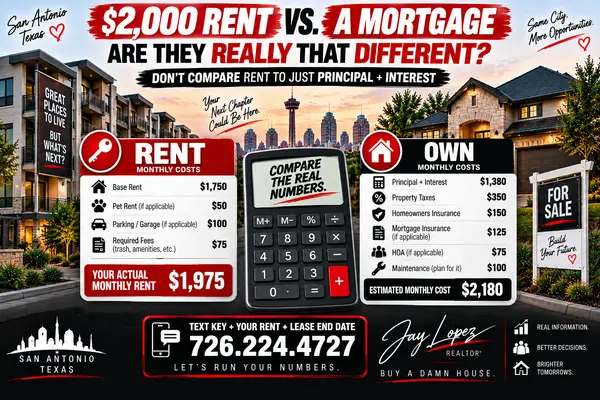
That's why I want buyers thinking about their total home-buying budget, not just their down-payment percentage.
9. Can the Seller Help With Some Costs?
Depending on the loan program, contract, negotiations and applicable limits, seller contributions toward certain buyer expenses may be possible.
But they're negotiated.
You shouldn't build your entire home-buying plan around the assumption:
“I'll just make the seller pay everything.”
Your Realtor can help structure and negotiate an offer, while your lender can explain which contributions are permitted under your financing.
Those two conversations need to work together.
10. New-Construction Buyers Should Ask About Builder Incentives
San Antonio has substantial new-construction activity, which gives buyers another area to explore.
Builders sometimes offer incentives on certain inventory homes or financing arrangements.
Depending on the promotion, these could involve:
Closing-cost assistance
Financing incentives
Rate-related incentives
Price reductions
Upgrades
But incentives change.
A promotion may apply only to certain homes, communities, lenders, closing dates or qualified borrowers.
So when you see:
“LOW RATE + CLOSING COSTS PAID!”
Don't stop reading after the headline.
Ask:
Which house?
Which lender?
Which loan program?
What qualifications?
How long is the promotion available?
Then compare the whole deal, not just the advertisement.
11. Let's Look at a Simple Example
Suppose you're considering a:
$300,000 home
A hypothetical 20% down payment would be:
$60,000
A hypothetical 10% down payment would be:
$30,000
A hypothetical 5% down payment would be:
$15,000
A hypothetical 3% down payment would be:
$9,000
A hypothetical 3.5% down payment would be:
$10,500
And an eligible zero-down financing program could potentially require:
$0 as the down payment.
These examples are not loan quotes or promises of qualification.
They're simply showing why you shouldn't automatically assume that buying a $300,000 house requires a $60,000 down payment.
The actual financing available to you depends on your qualifications and the program.
12. Don't Choose a Loan Based Only on the Down Payment
Here's another mistake I want first-time buyers to avoid.
Imagine you're presented with two financing options.
One requires less cash upfront.
The other requires more.
Which one is better?
We don't know yet.
We need to look at things like:
- Estimated monthly payment
- Interest rate
- Mortgage insurance
- Loan costs
- Cash needed at closing
- How long you expect to own the property
- Your financial reserves after closing
- Your overall financial goals
That's why shopping only for:
“THE LOWEST DOWN PAYMENT!”
can be just as problematic as assuming you need 20%.
Look at the entire financing picture.
13. What If You Don't Have Much Saved Right Now?
Don't panic.
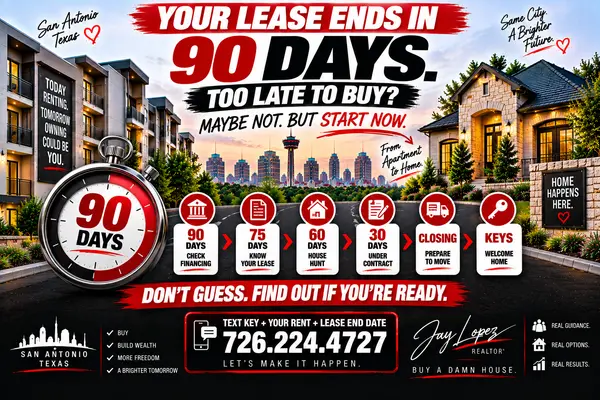
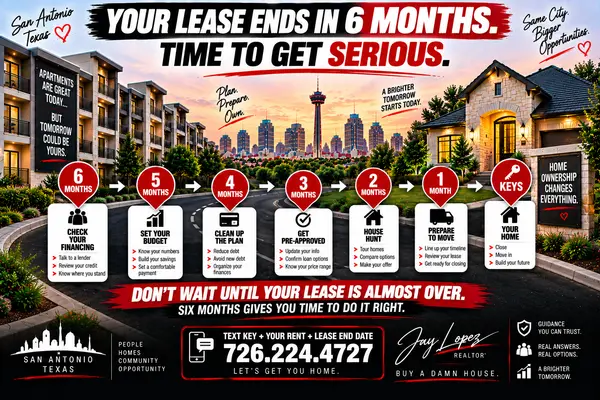
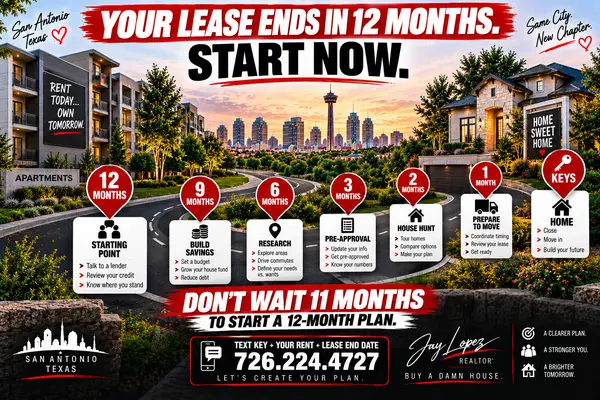
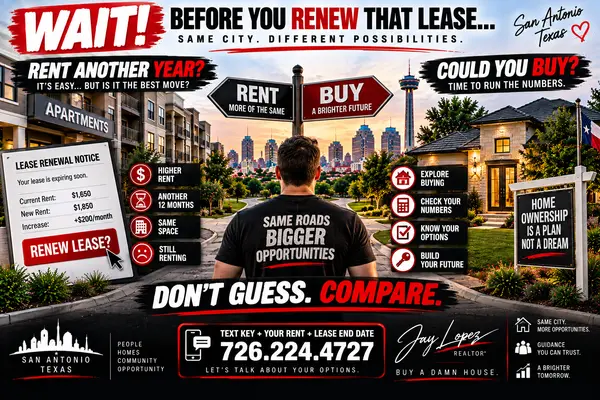
And don't automatically renew your lease for another year.
Find out where you stand first.
Maybe you're ready.
Maybe you need another $5,000.
Maybe you need six months.
Maybe you qualify for an option you didn't know existed.
Maybe buying right now doesn't make financial sense at all.
That's okay too.
I'd rather you know.
Because:
“I can't buy a house.”
and
“Here's what I need to do over the next six months to buy a house.”
are two completely different situations.
Before You Spend Another Year Saving for 20%, Find Out
If you're thinking about buying a home in San Antonio or the surrounding areas, don't wait until you've saved some arbitrary amount you think you're supposed to have.
Let's figure out what your actual options look like.
Tell me:
What are you paying in rent?
When does your lease end?
What monthly housing payment would feel comfortable?
Then we'll start building the game plan.
🔑 Text KEY to 726.224.4727
Tell me you're interested in low-down-payment options, and we'll start there.
Follow @jaylopezrealtor for San Antonio homes, new construction, first-time buyer education, VA information and real estate tips.
Buy a damn house.
Categories
Recent Posts