Rent vs. Buy in San Antonio: What Should Renters Consider?


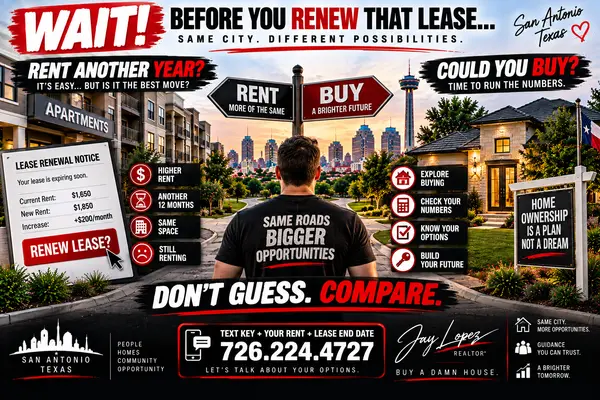
You're paying rent every month.
Maybe it's:
$1,400.
Maybe $1,800.
Maybe $2,200+.
Then somebody inevitably says:
“You're paying that much? You should just buy a house!”
Sounds simple.
Except it isn't.
Buying a home isn't automatically better than renting.
And renting isn't automatically throwing money away.
The better question is:
Which one makes more sense for your situation right now?
If you're renting in San Antonio and wondering whether it's time to make the jump into homeownership, here's how I'd look at it.
1. Start With Your Actual Rent
Pull up your lease.
What are you really paying each month?
Not just the advertised rent.
Consider recurring housing expenses such as:
Base rent
Parking
Pet rent
Required service packages
Garage or storage fees
and other recurring charges.
Maybe the apartment advertised at $1,650 actually costs you considerably more each month after everything is added.
That's the number we want when we begin comparing.
2. Now Compare That With the TOTAL Cost of Owning
This is where bad rent-vs.-buy comparisons happen.
Someone says:
“Your rent is $1,800 and the mortgage is $1,750. Buy!”
Not so fast.
A homeowner's monthly housing costs may include:
Principal
Interest
Property taxes
Homeowners insurance
Mortgage insurance, if applicable
HOA dues, if applicable
And homeowners should also plan for maintenance and repairs.
Compare the whole picture.
Not one number against another.
3. How Long Do You Expect to Stay?
This matters.
Suppose you're planning to leave San Antonio next year.
Buying may present a very different financial calculation than if you expect to stay for many years.
Buying and later selling a home involves transaction costs.
And home values aren't guaranteed to increase on your schedule.
So ask:
“How long do I realistically expect to own this home?”
Not:
“How long would I own it if everything went perfectly?”
Your real-life plans matter.
4. Military Buyers Need to Think About PCS Plans 🇺🇸
This is especially relevant around San Antonio.
If you're stationed at:
Lackland
Randolph
Fort Sam Houston
or another JBSA location, your timeline may look different from a civilian buyer's.
You might PCS.
You might retire locally.
You might eventually keep the property as a rental.
You might sell when you leave.
There isn't one correct answer.
The important thing is considering those possibilities before purchasing.
5. How Much Money Do You Have Saved?
Homeownership shouldn't begin with:
Closing day: $47 remaining in checking. 😂
Getting the keys isn't the end of your expenses.
It's the beginning of owning the house.
Ideally, you're thinking about:
Cash needed for the purchase
plus
Emergency reserves
plus
Moving expenses
plus
The inevitable trip to Home Depot where you somehow spend $438 on things you didn't know you needed.
Don't put yourself in a financial bind just to say:
“I'm a homeowner.”
6. You May Not Need a Huge Down Payment
At the same time, don't assume buying requires a massive down payment.
Qualified buyers may have access to lower-down-payment financing.
Depending on eligibility, possibilities can include:
Conventional
FHA
VA
USDA
and certain assistance programs.
VA financing can be particularly important in San Antonio because eligible borrowers with sufficient entitlement may be able to purchase without a down payment required by the VA loan program.
Different programs have different costs, eligibility requirements and tradeoffs.
The first step is learning which ones may apply to you.
7. What's Going On With Your Credit?
Your credit profile can affect:
Loan eligibility
Interest rate
Mortgage insurance
and potentially other financing terms.
But don't automatically decide:
“My credit isn't perfect, so I can't buy.”
Mortgage requirements vary by program and lender.
VA, for example, does not itself establish one universal minimum credit score, although lenders may establish their own requirements.
Talk with a qualified lender and find out where you actually stand.
8. What Does Your Debt Look Like?
Income matters.
But so does debt.
A lender may evaluate obligations such as:
Car loans
Credit cards
Student loans
Personal loans
and other qualifying monthly debts.
Someone earning $100,000 with significant monthly obligations may have a very different buying capacity than someone earning less with little debt.
This is another reason online affordability calculators are only a starting point.
9. Do You Want Flexibility?
Renting has a major advantage:
Flexibility.
When the lease ends, you may have the ability to move relatively easily, subject to your lease terms.
New job across town?
Move.
Transfer to another state?
Move.
Want a different neighborhood?
Move.
Selling a house is a larger process.
If flexibility is extremely important to you right now, renting may fit your lifestyle better.
10. Or Do You Want More Control Over Your Home?
Homeownership can offer something renters often want:
More control over their space.
Want to paint the office dark green?
Go for it.
Want a different backsplash?
It's your backsplash.
Want to improve the backyard?
Subject to applicable restrictions and permits, it's your property.
Want three dogs?
Well...
Let's still check the HOA documents. 😂
Owning may give you more control, but it also gives you more responsibility.
11. Who Fixes the Air Conditioner?
Apartment:
“Hello, maintenance?”
Homeowner:
“Well...that's not good.” 😂
When you own the property, maintenance becomes your responsibility unless an applicable warranty or other coverage applies.
That can include:
HVAC
Plumbing
Electrical
Roof
Appliances
Landscaping
and everything else that decides to break on a Saturday night.
Renters need to factor that responsibility into the decision.
12. What About Building Equity?
One potential benefit of homeownership is the ability to build equity over time.
Part of a typical principal-and-interest mortgage payment goes toward reducing the loan balance.
If the property's value increases over time, that may also contribute to equity.
But notice the word:
May.
Home appreciation isn't guaranteed.
And during the early years of an amortizing mortgage, a larger portion of the principal-and-interest payment typically goes toward interest than later in the loan.
So don't buy because somebody promised:
“This house will definitely be worth $100,000 more in five years.”
Nobody knows that.
13. Rent Isn't “Throwing Money Away”
I don't like that phrase.
Rent pays for something.
Housing.
You get a place to live.
You also get flexibility and typically shift many property-maintenance responsibilities to the landlord, subject to your lease and applicable law.
The question isn't whether rent disappears.
The question is:
Does continuing to rent fit your goals better than buying?
That's a much more useful conversation.
14. But Rent Doesn't Create Ownership in the Property
Here's the other side.
When you rent, your payments generally don't create ownership equity for you in the property.
You're purchasing the right to occupy the home under your lease.
When you own with a mortgage, you may build equity as principal is paid down and depending on changes in property value.
That distinction matters—especially for someone planning to remain in one place for a longer period.
15. What Happens If Rent Goes Up?
Rent can change when your lease renews.
Maybe it increases.
Maybe it doesn't.
If you own a home with a fixed-rate mortgage, the principal-and-interest portion of the payment generally remains fixed for the term of that loan.
But this is important:
Your total housing payment can still change.
Property taxes can change.
Insurance premiums can change.
HOA assessments can change.
So don't let anybody tell you:
“Buy a house and your payment can never increase.”
That's not accurate.
16. Don't Forget Property Taxes
Property taxes are an important part of the Texas homeownership equation.
The amount varies by property and taxing jurisdiction.
This is especially important when comparing homes in different areas.
Two homes with the same purchase price can potentially produce different total monthly costs.
Look at the property.
Look at the financing.
Look at the estimated taxes.
Then compare.
17. Don't Forget Insurance Either
Homeowners insurance can materially affect the monthly cost.
And insurance availability and premiums can depend on the property and insurer.
That's why I don't want buyers waiting until the last minute to investigate insurance.
Get quotes during the transaction and understand what you're purchasing.
18. What About an HOA?
Some communities have one.
Some don't.
HOA dues and assessments should be part of your affordability calculation when applicable.
But cost isn't the only consideration.
Review the relevant documents and restrictions.
The community might be perfect for you.
Or you may discover a restriction that conflicts with something you wanted to do with the property.
Know before you buy.
19. What Would You Do With the Money If You Keep Renting?
This is an underrated question.
Suppose buying would cost you more each month than renting.
If you keep renting, what happens to the difference?
Do you:
Save it?
Invest it?
Pay down debt?
Build an emergency fund?
Or does it disappear into:
Amazon, DoorDash and things you don't remember buying? 😂
Renting can be part of an excellent financial strategy.
But it helps to actually have a strategy.
20. What If You Need Another Year?
Great.
Then use the year.
Don't say:
“I'll buy next year.”
and then do absolutely nothing for 12 months.
Instead:
Month 1:
Talk with a lender.
Months 2–4:
Work on identified financial priorities.
Months 5–8:
Build savings and research areas.
Months 9–10:
Review your mortgage readiness.
Months 11–12:
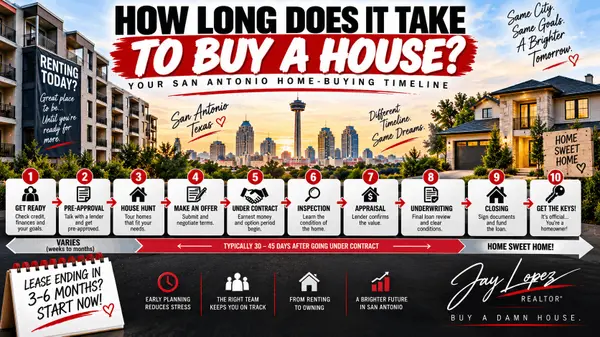
Prepare for your next lease expiration.
Now renting another year has a purpose.
21. What If You're Ready Right Now?
Then let's figure that out too.
If you have:
Stable income
A manageable debt picture
Funds appropriate for your transaction
A reason to stay in the area
and
A monthly ownership cost you're comfortable with
then it may be worth exploring homes.
Notice I didn't say:
“Go buy immediately.”
I said:
Explore it.
Information first.
Decision second.
22. Run the “What If?” Test
Before deciding, ask yourself:
What if I need to move sooner than expected?
What if the HVAC needs replacement?
What if my insurance increases?
What if I need a new vehicle?
What if the home doesn't appreciate quickly?
What if I stay here for ten years?
A good housing decision shouldn't require every part of your future to go perfectly.
23. Compare Real Homes, Not Hypothetical Ones
This is where things get useful.
Instead of saying:
“Buying seems expensive.”
Let's compare.
Take your current rental payment.
Then look at actual homes that might fit your needs.
Ask a lender to estimate financing based on your situation.
Now compare:
RENT
versus
A REAL HOME YOU COULD ACTUALLY BUY.
That's far more valuable than arguing about homeownership in theory.
My Rent-vs.-Buy Checklist
Before deciding, answer these:
How much am I actually paying to rent?
What would realistic homeownership costs look like?
How long do I expect to stay?
Do I have sufficient savings?
What does my mortgage profile look like?
How important is flexibility?
Am I comfortable handling maintenance?
What are my longer-term goals?
Then make the decision that fits your life.
Renting Isn't Losing. Buying Isn't Automatically Winning.
This isn't a competition.
The goal isn't to earn the title:
HOMEOWNER
as quickly as possible.
The goal is to make a housing decision that supports where you're trying to go.
Maybe that's renting.
Maybe that's buying.
Maybe that's renting for six more months while we prepare.
But let's use actual information to decide.
Want to Compare Your Rent to Buying?
Let's make it ridiculously simple.
🔑 Text KEY to 726.224.4727
Send me:
Your monthly rent
Your lease expiration
and
The area of San Antonio you'd like to live in.
Example:
“KEY — $1,850 — March — Northeast San Antonio.”
We'll start there.
No need to decide you're buying a house before we even run the numbers.
Follow @jaylopezrealtor for San Antonio homes, new construction, VA information, first-time buyer education and real estate tips.
Buy a damn house.
Categories
Recent Posts