How to Prepare to Buy a Home 6 Months Before Your Lease Ends

You look at the calendar.
Your lease ends in six months.
And suddenly that idea you've had for the last three years—
“Maybe I should buy a house.”
—doesn't feel quite so far away anymore.
Good.
Six months can give you meaningful time to prepare.
But we're officially past:
“I'll worry about it later.” 😂
If you want the option of buying when your lease ends, now is the time to figure out where you stand.
Here's the six-month game plan.
6 Months Out: Talk to a Mortgage Lender
This is step one.
Not Zillow.
Not touring model homes.
Not driving through neighborhoods picking out houses.
Start with the money.
Talk with a qualified mortgage lender and explain:
“My lease expires in six months, and I'd like to see if I can prepare to buy.”
You're not committing to purchase a house.
You're gathering information.
What Should You Find Out?
Your lender can help you understand things such as:
Your current mortgage profile
Potential financing options
Credit factors affecting qualification
Debt-to-income considerations
Possible down-payment requirements
Estimated cash needed
and
What may need attention before you're ready.
You might discover you're ready now.
You might discover you need a few months.
Either way, six months gives us time to work with actual information.
Don't Disqualify Yourself First
This is especially important.
I've seen renters assume:
“My credit isn't high enough.”
“I need 20% down.”
“I have too much debt.”
“VA loans are too complicated.”
“I won't qualify.”
Maybe there is something we need to address.
But don't make the lender's decision for them.
Find out where you actually stand.
5 Months Out: Build the Financial Plan
Now that you have more information, it's time to get organized.
Start with your comfortable monthly housing budget.
Not:
“What's the biggest mortgage I can get?”
Instead:
“What payment fits comfortably into my life?”
Those are very different questions.
Look at the Entire Monthly Payment
Depending on the property and financing, homeownership costs may include:
Principal
Interest
Property taxes
Homeowners insurance
Mortgage insurance, if applicable
HOA costs, if applicable
plus maintenance and repairs.
Don't build your budget around principal and interest alone.
Start Practicing Your Future Payment
Let's say:
Current rent and recurring rental costs:
$1,750/month
Comfortable estimated future housing budget:
$2,050/month
Consider setting aside the:
$300 difference
each month.
After several months, you've accomplished two things.
First, you've added to your savings.
Second, you've tested the payment.
If the additional $300 makes your budget miserable?
That's valuable information.
Maybe $2,050 isn't your comfortable number.
Build Your House Fund
At six months out, I want your house money separated from your everyday spending.
Depending on your eventual transaction, you may need funds for:
Down payment
Closing costs
Prepaid expenses
Earnest money
Option fee
Inspection
Moving expenses
and reserves after closing.
You may not need every one of these in the same way for every transaction.
But we want to be prepared.
4 Months Out: Clean Up the Financial Picture
Now we're getting closer.
If your lender identified specific financial issues, this is the time to work on them.
That might involve:
Reducing certain debt
Building savings
Correcting legitimate credit-report errors
Keeping payments current
or another lender-recommended step.
But don't start experimenting with your credit.
Please Don't Buy the Truck Yet 😂
You're preparing for a mortgage.
This probably isn't the ideal time to suddenly finance:
$65,000 worth of shiny new pickup truck.
New debt can change your financial picture.
The same goes for:
New credit cards
Furniture financing
Personal loans
and other major obligations.
Before making a significant financial change while preparing for a mortgage, talk with your lender.
Don't Move Large Amounts of Money Around Without Asking
Another common mistake:
The buyer suddenly transfers money between accounts.
Or receives a large deposit.
Or moves savings.
Then underwriting starts asking questions.
Mortgage lenders may need documentation regarding funds used in the transaction.
So as you get closer to purchasing:
Keep your financial life boring.
Boring is good. 😂
If you're unsure about moving money, ask your lender first.
3 Months Out: Get Serious About Pre-Approval
Now we're about 90 days from the end of your lease.
If your lender believes you're financially ready, this may be the time to move toward a mortgage pre-approval appropriate for your timeline.
Why?
Because we're getting close to actual house hunting.
Pre-approval can help us understand:
Potential price range
Estimated monthly payment
Financing structure
Possible cash needed
and
How you're positioned to make an offer.
Don't Shop at the Maximum Just Because You Can
Suppose you're pre-approved up to:
$400,000.
That does not mean our search automatically becomes:
$395,000–$400,000. 😂
Maybe your comfortable payment points us toward:
$325,000.
Great.
That's our number.
The lender establishes what financing may be available.
You decide what fits your life.
Compare Loan Options
Depending on your eligibility, your lender may discuss:
Conventional financing
FHA
VA
USDA
or other programs.
Don't compare them using only:
Down payment.
Look at the broader picture:
Estimated payment
Mortgage insurance
Upfront costs
Loan terms
Eligibility
and your longer-term plans.
VA Buyers: Use the Benefit You Earned 🇺🇸
San Antonio has a massive military community.
If you're an eligible Veteran or service member, six months out is a great time to learn exactly how your VA benefit applies to you.
Eligible borrowers with sufficient entitlement may potentially purchase without a down payment required by the VA loan program.
VA doesn't itself establish a universal minimum credit score, although lenders may impose their own requirements.
VA-backed loans also don't have monthly mortgage insurance.
Some eligible Veterans may be exempt from the VA funding fee.
That doesn't mean every VA transaction requires zero cash.
Closing costs and prepaid expenses may still apply.
Learn your actual numbers.
3 Months Out: Start Researching Areas
Now we're getting into the fun stuff.
Where around San Antonio might you want to live?
Instead of asking:
“What's the best neighborhood?”
Let's ask:
“What areas fit your needs?”
Consider:
Commute
Budget
Home type
Lot size
New construction vs. resale
HOA preferences
Access to places important to you
and your plans for the next several years.
Drive the Commute
Please do this.
A house might look:
“Only 20 miles from work.”
San Antonio traffic may have opinions about that. 😂
If commute matters, test it around the times you actually travel.
This can be particularly important for buyers commuting to JBSA installations or across different parts of the metro.
2 Months Out: Start House Hunting
Now we're ready.
You know:
Your financing
Your comfortable budget
Your target areas
Your priorities
and
Your lease timeline.
Let's start looking at actual homes.
Build the Search Around the Payment
Don't simply say:
“Show me everything under $400,000.”
Remember that taxes, insurance and HOA costs can vary between properties.
Two homes at the same price may not produce the same estimated monthly housing cost.
When you find something you like, have the lender help you evaluate the property-specific payment.
Resale vs. New Construction
At this point, we should probably look at both if both fit your goals.
A resale home may offer:
Established surroundings
Different lot characteristics
Existing improvements
and a potentially different negotiation environment.
New construction may offer:
New systems
Builder warranties
Different floor plans
and potentially current builder incentives.
Neither is automatically better.
Compare them.
Builder Incentives Can Change the Numbers
Builders sometimes offer incentives on qualifying homes.
Depending on current promotions, these might involve:
Closing-cost assistance
Rate incentives
Temporary or permanent buydowns
Price adjustments
or other offers.
These programs change frequently.
They also come with qualification requirements.
Verify everything before relying on an advertised incentive.
Bring Your Realtor Before You Register With the Builder
If you want your own Realtor involved in a new-construction purchase, it's smart to have that conversation before you begin registering with builders or signing documents.
Builder policies regarding outside agents can vary.
And remember:
The builder's sales representative represents the builder.
Having your own representation can help you evaluate the transaction from your side.
Found the House? Now We Build the Offer.
Once we find a property you want, we don't just yell:
“FULL PRICE! SEND IT!” 😂
We look at the available information.
That may include:
Comparable properties
Current competition
Property condition
Financing
Seller priorities when known
and
The contract terms that matter to you.
Then we build the offer.
1–2 Months Out: You're Under Contract
Now the timeline gets serious.
Depending on your contract and transaction, we'll begin tracking things such as:
Earnest money
Option fee
Inspection
Financing
Appraisal
Title
Insurance
Negotiated repairs
and
Closing.
This is why preparing six months early helps.
You're not trying to learn everything while a contract clock is running.
Get Your Inspection Done Early
If your contract includes a negotiated termination option, use that time wisely.
Schedule appropriate inspections promptly.
If the inspector identifies something that warrants additional evaluation, you'll want enough time to investigate before applicable deadlines expire.
Remember:
The option period isn't vacation time.
The clock is running.
Don't Open New Credit While You're Under Contract
You found the house.
You're excited.
So naturally...
Time to finance $14,000 worth of furniture!
No. 😂
Your lender may continue verifying your financial information before closing.
Avoid significant credit or financial changes without discussing them with your lender.
That includes:
New vehicles
New credit cards
Furniture financing
Large purchases
and other changes.
Wait until the transaction is completed and consult your lender when uncertain.
Start Homeowners Insurance Early
Don't wait until two days before closing.
Once you're under contract, begin investigating insurance.
Your lender will have insurance requirements.
The property itself can also affect availability and pricing.
Get quotes.
Understand the coverage.
Know what it does to your payment.
30 Days Out: Review Your Lease
We're almost there.
Pull the lease out.
Actually read it.
Pay attention to:
Expiration
Required notice
Move-out procedures
Automatic renewal provisions
and any other relevant requirements.
Don't assume:
“The lease ends May 31, so I just leave May 31.”
Your lease may require advance notice or contain other obligations.
Follow the agreement you signed.
Don't Give Notice Too Early Without a Plan
Here's another reason timing matters.
Suppose you give notice that you're leaving.
Then your home transaction encounters a delay.
Now what?
Build your lease strategy carefully.
If you're unsure about your rights or obligations under the lease, obtain appropriate legal guidance.
Closing Week: Don't Send Money Without Verifying Instructions
We're almost at the finish line.
And this is where I want you extremely cautious.
Real estate wire fraud is real.
If you receive wiring instructions electronically, independently verify them with the title company using trusted contact information.
If someone emails:
“Our wiring instructions changed.”
STOP.
Verify.
Never let an urgent-looking email convince you to send money without confirming the instructions.
Final Walk-Through
Before closing, buyers typically have an opportunity under the contract to conduct a final walk-through.
This isn't another full home inspection.
We're checking the property shortly before closing and looking at matters such as its condition and any agreed items relevant to the transaction.
Then...
🔑 Closing Day
You sign.
The transaction completes according to the closing and funding process.
And eventually you get the message you've been working toward:
THE KEYS ARE YOURS.
Six months earlier you were sitting in an apartment thinking:
“Maybe someday.”
Now you're carrying boxes into your own place.
That's why we start early.
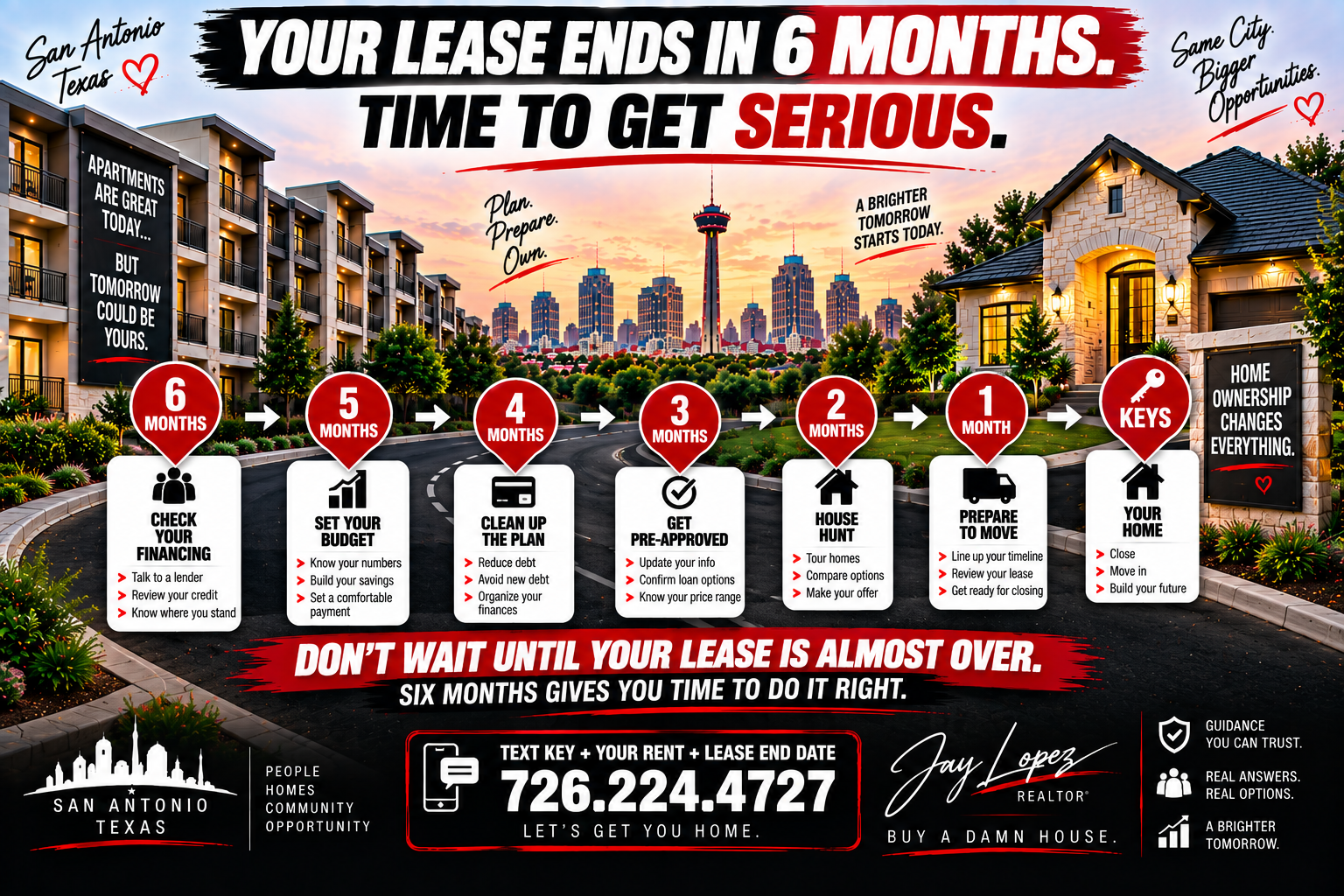
Your 6-Month Home-Buying Checklist
Here's the simplified version:
6 MONTHS
Talk with a lender and establish your starting point.
5 MONTHS
Set your budget and build savings.
4 MONTHS
Work on identified financial priorities and avoid unnecessary new debt.
3 MONTHS
Update financing, work toward pre-approval and research areas.
2 MONTHS
Begin serious house hunting if ready.
1 MONTH
Coordinate contract, financing, closing and lease obligations.
🔑 KEYS
Move into your home.
Six Months Is Enough Time to Make Progress
Don't panic because your lease ends in six months.
But don't ignore it either.
You don't need to know today whether you'll definitely buy.
You need to know:
What would have to happen for buying to become an option?
That's what the next six months are for.
Your Lease Ends in Six Months?
Let's build your timeline now.
🔑 Text KEY to 726.224.4727
Send me:
Your monthly rent
Your lease expiration
and
Where you'd like to live around San Antonio.
Example:
“KEY — $1,900 — March — near Randolph.”
We'll start with the plan.
Follow @jaylopezrealtor for San Antonio homes, new construction, VA information, first-time buyer education and real estate tips.
Buy a damn house.
Categories
Recent Posts