Should You Get Pre-Approved Before Looking at Homes in San Antonio?

You've decided you want to buy a house.
So naturally, what's the first thing you want to do?
GO LOOK AT HOUSES. 🏠
I get it.
Touring homes is fun.
Talking about income, credit, bank statements and mortgage payments?
Not nearly as exciting. 😂
But here's the problem:
You can spend an entire Saturday falling in love with a house only to discover that the payment doesn't fit your budget—or that there's something with your financing we needed to address first.
That's why I generally want buyers talking with a lender before we get serious about house hunting.
Let's talk about why.
1. What Is a Mortgage Pre-Approval?
A mortgage pre-approval is a lender's preliminary evaluation of your ability to obtain financing based on financial information and documentation you provide.
Depending on the lender and loan program, the lender may review things such as:
- Income
- Employment
- Credit
- Assets
- Existing debts
- Down-payment funds
- Loan-program eligibility
- Other financial information
If you satisfy the lender's preliminary requirements, they may issue a pre-approval indicating a potential financing amount, subject to conditions.
The key phrase there is:
Subject to conditions.
A pre-approval isn't a guarantee that your mortgage will ultimately close.
The property still matters.
Your financial circumstances still matter.
Underwriting still matters.
But it gives us a much better starting point.
2. Pre-Approval Helps Establish Your Price Range
Imagine we start touring houses without talking to a lender.
You fall in love with a:
$425,000 home.
Beautiful kitchen.
Huge primary bedroom.
Perfect backyard.
You're already deciding where the furniture goes.
Then we finally talk to a lender and discover the numbers you're comfortable with put us closer to:
$350,000.
Now every $350,000 house gets compared to the $425,000 house.
That's not fun.
I'd rather establish a realistic range before we fall in love with the wrong house.
3. Your Maximum Approval Isn't Necessarily Your Budget
This is important.
Let's say your lender determines you may qualify up to:
$400,000.
Does that mean we're automatically shopping from:
$395,000–$400,000?
No.
I want to know what monthly housing payment you're comfortable with.
Maybe the lender says you can qualify for a particular amount, but you'd rather spend less so you still have money for:
Travel.
Restaurants.
Savings.
Retirement.
Hobbies.
Life.
That's completely reasonable.
You don't have to spend everything you're approved to borrow.
4. Pre-Approval Helps Us Understand Your Monthly Payment
A purchase price by itself doesn't tell the whole story.
Your estimated housing payment can involve:
Principal
Interest
Property taxes
Homeowners insurance
Mortgage insurance when applicable
HOA expenses when applicable
and other costs.
That's particularly important when comparing different properties around San Antonio.
Two homes with similar prices can potentially have different estimated monthly costs.
Before you tell me:
“Jay, I want to stay under $400,000.”
I'd rather know:
“Jay, I want my housing payment around $____.”
Now we can build a better search.
5. You May Discover Financing Options You Didn't Know About
Some buyers assume:
“I'll just get a conventional mortgage.”
But depending on your circumstances, a lender may discuss several potential financing options.
Those could include:
Conventional
FHA
VA
USDA
or other available programs.
Different programs can have different requirements involving:
Down payment
Credit
Property eligibility
Mortgage insurance
Fees
and other factors.
Pre-approval isn't only about answering:
“How much can I borrow?”
It's also an opportunity to start answering:
“How should I finance this?”
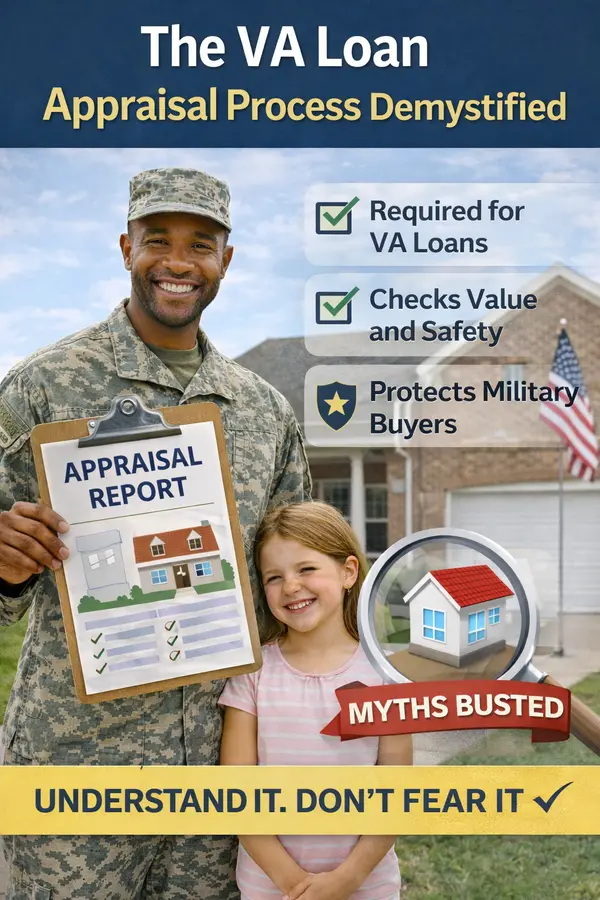
6. VA Buyers Should Do This Early 🇺🇸
San Antonio has a huge military community, so this is especially important for Veterans and active-duty buyers.
If you're considering a VA-backed home loan, talking with a lender early can help you understand things such as:
VA eligibility
Certificate of Eligibility
Entitlement
Potential funding fee
Possible funding-fee exemption
Lender requirements
and your estimated financing.
Remember:
VA itself does not establish a universal minimum credit score for the VA home loan guaranty.
Individual lenders can establish credit standards.
So don't tell yourself:
“My credit isn't high enough for VA.”
Let an appropriate lender evaluate your actual situation.
7. What If Your Credit Isn't Ready?
This is another reason I like starting early.
Imagine your lease ends in eight months.
You talk with a lender today.
They review your credit and say:
“You're not quite ready yet.”
That's disappointing.
But you know what you also have?
Eight months.
Now you can find out what issues need attention and create a plan.
Compare that with waiting until your lease expires in 30 days.
Same credit issue.
Very different situation.
Early information gives you options.
8. Pre-Approval Can Help You Understand How Much Cash You May Need
A lender can also help estimate the financial side of purchasing.
Depending on the transaction, that could involve:
Down payment
Estimated closing costs
Prepaid expenses
Cash reserves
and other financing considerations.
This is where many first-time buyers discover:
You don't necessarily need 20% down.
Depending on eligibility and program requirements, lower-down-payment or even qualifying zero-down-payment options may exist.
But we need to know which programs actually apply to you.
9. Pre-Approval Helps When It's Time to Make an Offer
Now we get to the practical real estate side.
You find the house.
You want it.
We're preparing an offer.
A seller considering a financed offer will typically want information showing that the buyer has taken steps toward obtaining financing.
A pre-approval can help demonstrate that you've already spoken with a lender and gone through a preliminary financial review.
That doesn't guarantee your offer will be accepted.
But trying to figure out financing after you find the house can put you behind buyers who already did the work.
10. Pre-Approval Doesn't Mean You Have to Buy
Some buyers avoid getting pre-approved because they think:
“I'm not ready to buy tomorrow.”
That's okay.
Talking with a lender doesn't mean I'm showing up at your house with a moving truck on Saturday. 😂
You can start gathering information months before you're ready.
Maybe you learn:
You're ready now.
Maybe:
You need six months.
Maybe:
Buying doesn't make sense yet.
That's useful information.
The goal is to make an informed decision.
11. Pre-Qualification and Pre-Approval Aren't Always the Same Thing
You'll hear both terms used in mortgage conversations.
Different lenders may use the terminology somewhat differently, so don't focus only on what the document is called.
Ask:
What information did the lender review?
Was credit reviewed?
Were income and assets documented?
What conditions remain?
Has an underwriter reviewed anything yet?
Understanding the depth of the lender's review is more useful than simply assuming every letter means the same thing.
12. Is Pre-Approval a Guarantee?
No.
This is worth repeating.
A pre-approval is not a guarantee of final loan approval.
Things can still change.
For example:
Your financial situation could change.
The property might not satisfy applicable financing requirements.
The appraisal could create an issue.
Underwriting could require additional information.
That's why I keep telling buyers:
Don't make major financial moves while buying a house.
Which brings us to...
13. Please Don't Buy a Car After Getting Pre-Approved 😂
You got pre-approved.
Great.
Then you go celebrate by financing a new truck.
Not great.
New debt can potentially affect your credit profile and debt-to-income ratio.
The same caution applies to things such as:
Opening new credit cards
Financing furniture
Taking out personal loans
Co-signing
Changing jobs without discussing it
or making other major financial moves.
Before doing something significant:
Call your lender.
Seriously.
The furniture store will still be there after closing.
14. Don't Move Large Amounts of Money Around Without Asking
Your lender may need to document funds used in the transaction.
If you suddenly move significant amounts among accounts or receive unusual deposits, the lender may need additional documentation.
That doesn't necessarily mean you can't move money.
It means:
Ask first.
Your lender can tell you what documentation may be needed.
Mortgage underwriting likes explanations.
Mortgage underwriting does not like mysteries. 😂
15. How Far in Advance Should You Get Pre-Approved?
This depends on your situation.
If you're planning to buy very soon:
Start now.
If your lease ends in several months:
Starting the conversation now can still be useful.
If you're a year away and concerned about credit or savings:
Starting early may be even more valuable.
Keep in mind that lenders may need to update financial documentation and credit information as time passes.
A pre-approval isn't necessarily something you obtain once and keep forever.
Your lender can tell you when updated information is required.
16. Should You Talk to More Than One Lender?
You can compare lenders and financing options.
When doing so, don't compare only:
Interest rate.
Also consider applicable:
Loan costs
Points
Estimated payment
Cash to close
Loan program
Service
Communication
and other relevant terms.
The lowest number in a giant advertisement isn't necessarily the whole story.
You want financing that makes sense and a lender capable of helping get the transaction to closing.
17. What Documents Should You Have Ready?
Your lender will tell you exactly what they need.
Depending on your financial situation, be prepared for requests involving items such as:
Identification
Income documentation
Bank or asset statements
Employment information
Debt information
and other documents relevant to your loan.
Self-employed borrowers, Veterans and buyers with other income structures may have additional documentation requirements.
Don't worry about memorizing the list.
Just respond promptly when your lender asks.
18. What Happens After You're Pre-Approved?
Now we can do the fun part.
🏠 HOUSE HUNTING.
We'll take what we learned and build your search around:
Your comfortable budget
Financing
Location
Property needs
Commute
Lifestyle
and other priorities.
Now when we walk into a house you love, we're not starting from:
“I wonder if this is even possible.”
We're starting from:
“Does this house make sense for you?”
That's a much better place to be.
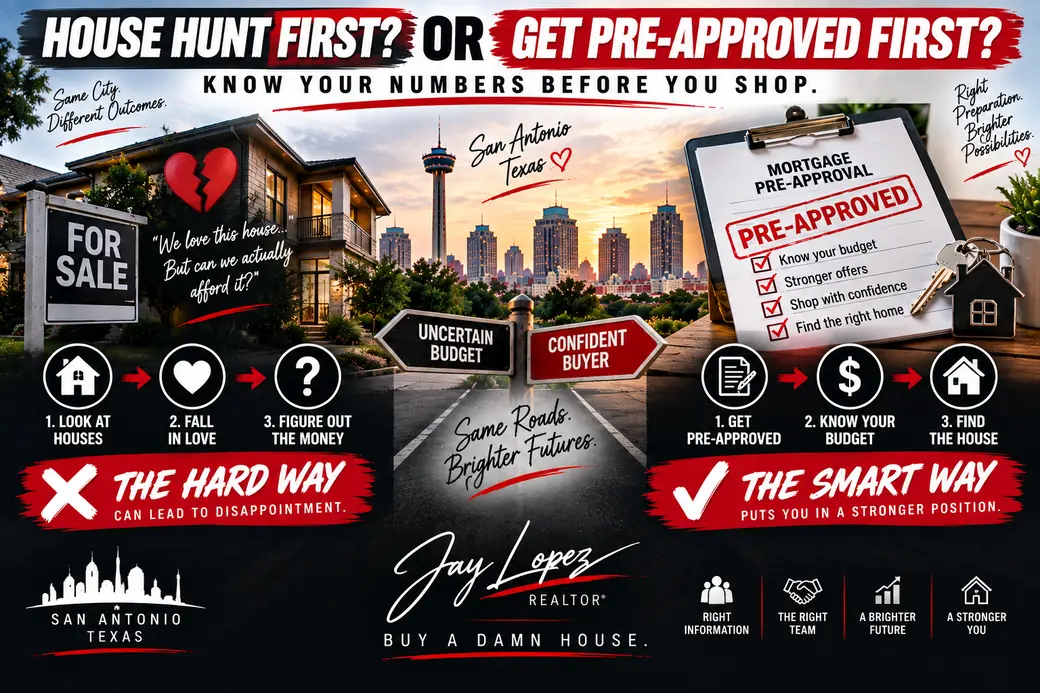
Stop Shopping Backward
A lot of buyers do this:
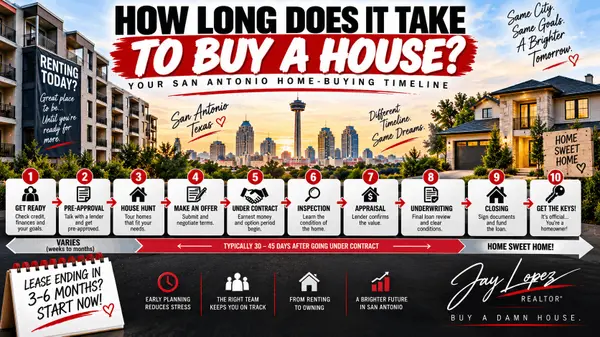
House → Fall in love → Talk to lender → Find out numbers.
I'd rather do this:
Lender → Understand numbers → House hunt → Find the right house.
It isn't as exciting at the beginning.
But it can make the rest of the process a whole lot easier.
Ready to Find Out What Your Numbers Look Like?
You don't have to know which loan you want.
You don't have to know your exact credit score.
You don't have to know how much house you can afford.
That's why we start the conversation.
🔑 Text KEY to 726.224.4727
Tell me:
“I need to get pre-approved.”
I'll help you get pointed in the right direction so we can figure out the financing side before we start seriously shopping.
Then?
We go find the house. 🏠
Follow @jaylopezrealtor for San Antonio homes, new construction, VA information, first-time buyer education and real estate tips.
Buy a damn house.
Featured Image
For Blog #11, let's make the contrast instantly understandable.
Image Headline
HOUSE HUNT FIRST? OR GET PRE-APPROVED FIRST?
Then visually:
❌ HOUSE → FALL IN LOVE → FIGURE OUT MONEY
versus
✓ PRE-APPROVAL → KNOW YOUR BUDGET → FIND THE HOUSE
Secondary headline:
KNOW YOUR NUMBERS BEFORE YOU SHOP.
I'd show Jay's established San Antonio visual theme with a modern home on one side, a mortgage/pre-approval document on the other, and the Tower of the Americas / San Antonio skyline behind it.
Black, white and deep red branding.
Jay Lopez | REALTOR®
Buy a damn house.
Categories
Recent Posts