How Long Does It Take to Buy a House in San Antonio?
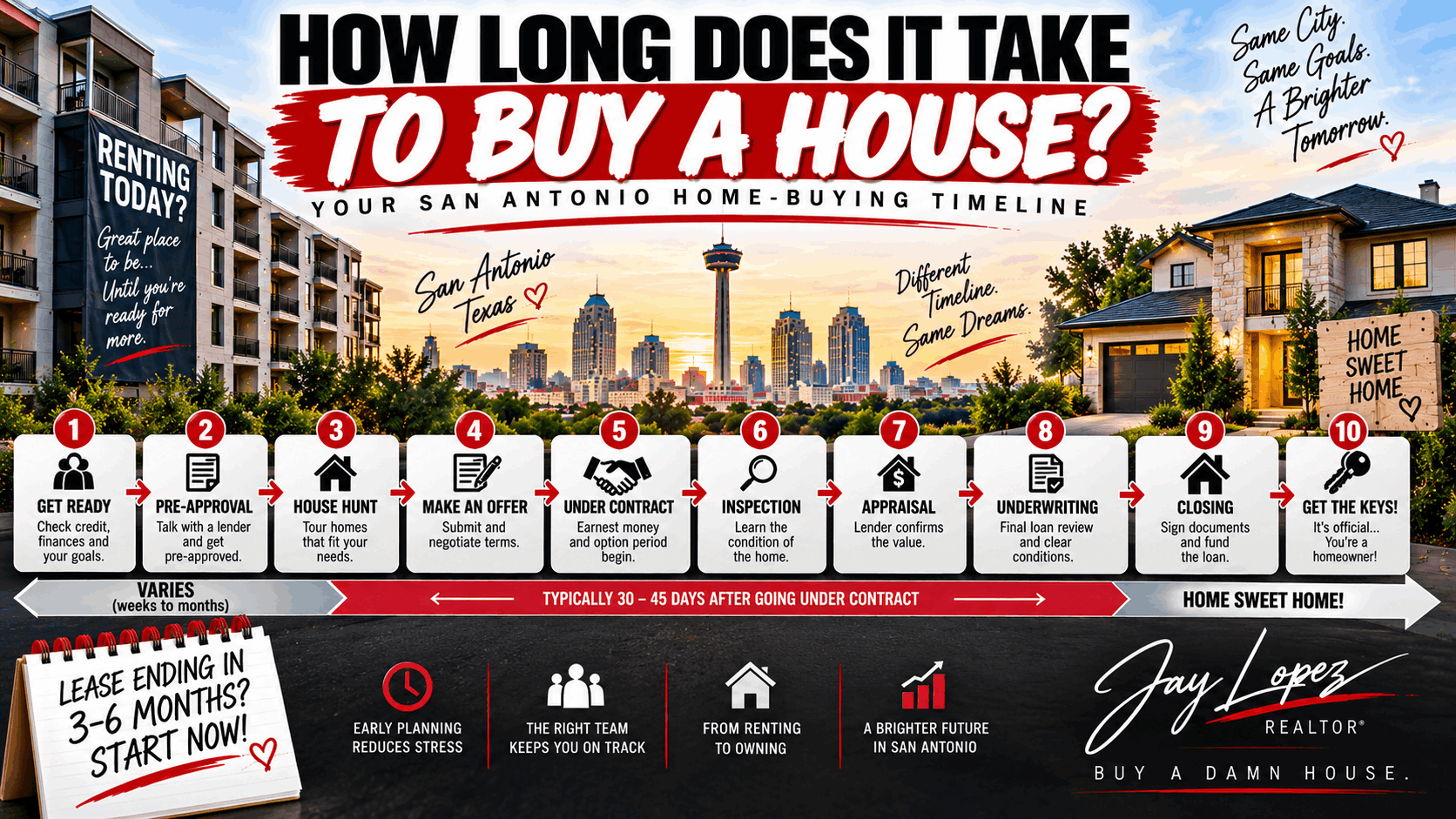
One of the first questions I get from buyers is:
“How long does it actually take to buy a house?”
My favorite version comes from renters:
“Jay, my lease ends in three weeks. Can I buy a house before then?” 😂
Maybe.
But I'd really rather have this conversation before you're packing boxes.
The truth is there isn't one exact timeline for buying a house.
Some buyers find a home quickly.
Others search for months.
Some financing and transactions move smoothly.
Others hit appraisal, inspection, title, financing or negotiation issues that require additional time.
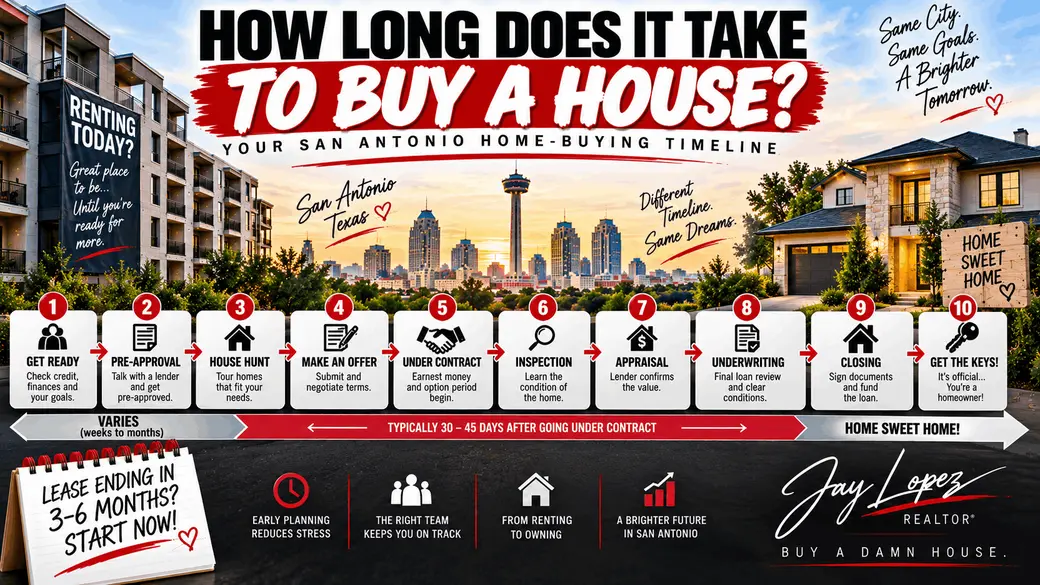
So instead of promising you a magic number of days, let's walk through the process and show you when you should actually start.
Phase 1: Getting Financially Ready
Before we start looking at houses, we need to know what you're financially prepared to buy.
For some buyers, this stage can happen fairly quickly.
For others, it may take months.
Why?
Because you might discover you need to:
- Improve your credit profile
- Save additional money
- Reduce debt
- Gather financial documentation
- Establish qualifying income
- Resolve financing issues
- Explore different loan programs
This is why I encourage potential buyers to start the conversation early.
If you're ready now, great.
If you're not, now we have time to build a plan.
Phase 2: Mortgage Pre-Approval
Once you're financially prepared, the next step is typically talking with a mortgage lender.
The lender may ask you for information and documents involving things such as:
Income
Employment
Assets
Debts
Credit
Identification
and other information needed for the mortgage process.
How quickly this happens depends partly on you.
If your lender asks for documents Monday and you send them Monday?
Great.
If you send half on Friday and the rest next Wednesday?
Well...
We just made the process longer. 😂
Buyer tip:
When your lender requests documentation, respond as quickly and completely as possible.
Phase 3: Building Your Home Search
Once we understand your financing and comfortable budget, we build your search.
We'll discuss:
Location
Price
Monthly payment
Bedrooms
Bathrooms
Square footage
New construction vs. resale
Commute
Property features
and your other priorities.
This part can happen pretty quickly.
But your priorities may change once we actually start touring homes.
That's normal.
Phase 4: House Hunting 🏠
This is the least predictable part.
You might find the right house:
The first weekend.
Or you could search for:
Several weeks or several months.
It depends on things such as:
- Your budget
- Available inventory
- Location
- Property requirements
- Market conditions
- How flexible you are
- Whether you're considering new construction
- How quickly you're prepared to make decisions
The more specific the requirements, the longer the search may take.
For example:
“I want a 3-bedroom house somewhere around San Antonio.”
gives us a lot of possibilities.
But:
“I need exactly four bedrooms, a three-car garage, huge backyard, no HOA, newer construction, this specific area, and it has to be under $300,000.”
Now you've given me a treasure hunt. 😂
Phase 5: Making an Offer
Once you find a house you want, we'll prepare an offer.
This involves more than choosing a price.
We'll discuss terms involving things such as:
Purchase price
Financing
Earnest money
Option period
Closing date
Potential seller contributions
and other applicable contract terms.
The seller may:
Accept
Reject
or
Negotiate
your offer.
Sometimes an agreement happens quickly.
Other negotiations take longer.
And sometimes the buyer and seller simply don't reach an agreement.
If that happens?
We go back to the search.
Phase 6: You're Under Contract 🎉
Once the contract is executed, things start moving quickly.
Now several processes may happen at the same time.
Your:
Realtor
Lender
Title company
Inspector
Appraiser
Insurance provider
and others may all be working on different parts of the transaction.
This is where staying responsive becomes really important.
Phase 7: Earnest Money and Option Fee
Texas contracts contain specific deadlines.
If your contract requires earnest money and an option fee, those funds must be delivered according to the contract.
This isn't something to put on your:
“I'll do that when I get around to it” list.
Your Realtor should explain exactly:
What is due
Where it goes
and
When it's due.
Phase 8: Inspection and Option Period
If your contract provides for a termination option, buyers commonly use this period to conduct inspections and evaluate the property.
You'll schedule your inspector.
The inspection occurs.
You receive the report.
Then you and your Realtor discuss what you've learned and what options are available under the contract.
Depending on what is discovered, you might need additional evaluations.
For example, a general inspector could recommend that a particular system or issue be evaluated by an appropriate specialist.
That can add time and urgency during a negotiated option period.
Phase 9: Mortgage Processing
While you're focused on the house, your lender is working on your mortgage.
You may be asked for:
Updated bank statements
Pay information
Employment verification
Explanations
Additional documentation
or other items.
Don't assume:
“I was pre-approved, so I'm finished.”
You're not finished until the loan has completed the required process and the transaction closes.
And please...
Don't finance a truck while we're doing this. 😂
Before taking on new debt or making major financial changes, talk with your lender.
Phase 10: The Appraisal
For most financed purchases, the lender will require an appraisal.
The appraiser evaluates the property for the lender's valuation purposes.
If everything supports the transaction, we keep moving.
If there's an appraisal issue, additional steps may be necessary depending on the contract, financing and circumstances.
This can potentially affect the timeline.
It's one reason I don't promise every buyer:
“You will absolutely close on this exact day no matter what.”
We work toward the contractual closing date, but issues can arise that need to be handled appropriately.
Phase 11: Title Work
At the same time, the title company is working on the title side of the transaction.
Among other things, the title process can involve reviewing matters affecting ownership and preparing for closing.
You may receive a title commitment and other documents during the transaction.
Review what you're sent.
If you don't understand something:
Ask.
Don't assume every document sent electronically is just another box you need to click.
Phase 12: Homeowners Insurance
If you're financing the home, you'll generally need homeowners insurance that satisfies lender requirements.
Start getting quotes early enough that insurance doesn't become a last-minute scramble.
Your premium can also affect your expected monthly housing expense.
This is another reason we don't calculate affordability using only principal and interest.
Phase 13: Underwriting
Mortgage underwriting is an important part of the financing process.
The underwriter reviews the loan file to determine whether it satisfies applicable requirements.
Sometimes they request additional documentation.
That's normal.
But here's what doesn't help:
Ignoring the lender for three days. 😂
If they need something, get it to them.
Every day we spend waiting for documents can potentially make the closing timeline more difficult.
Phase 14: Closing Disclosure
For many mortgage transactions, federal rules require the borrower to receive a Closing Disclosure before consummation, subject to applicable timing requirements.
This document shows important information about the mortgage and closing.
Review it carefully.
This is where you'll see information involving your:
Loan terms
Payments
Closing costs
Credits
Cash to close
and other transaction details.
If something doesn't make sense, ask your lender or appropriate closing professional.
Phase 15: Final Walk-Through
We're almost there. 🔑
Shortly before closing, buyers typically conduct a final walk-through.
This gives you an opportunity to view the property's condition before closing and address appropriate concerns if something has materially changed or agreed matters require attention.
This is not normally intended to be another full inspection.
It's our last look before closing.
Phase 16: Closing Day
Now you sign.
And sign.
And sign.
And then:
“Wait...another signature?” 😂
Your closing professionals will guide you through the required documents and funds.
Be especially careful with wiring instructions.
Wire fraud is real.
Never rely on unexpected or changed wiring instructions received electronically without independently verifying them with the title company through a trusted contact method.
Phase 17: Funding and Possession 🔑
Signing documents doesn't necessarily mean the transaction has completed that exact second.
The closing and funding requirements still need to be satisfied.
Possession is also governed by the contract.
Once everything required has occurred and you're entitled to possession:
YOU GET THE KEYS.
And suddenly all those emails, documents, inspections and signatures were worth it.
So How Long Should You Plan For?
Instead of promising one exact timeline, I like to think about buying in two parts.
Before You're Under Contract
This could be very short—or several months.
It depends primarily on:
Your financial readiness + how long it takes to find the right property.
After You're Under Contract
The timeline is determined by your negotiated contract and affected by the financing and transaction.
Your Realtor and lender can help you establish a realistic target based on the specific purchase.
When Should Renters Start?
This is where I want people to stop waiting until the last minute.
If your lease expires in:
6–12 months
Great.
Let's see where you stand.
Maybe you need to improve credit or save additional money.
We have time.
3–6 months
Definitely start the conversation.
This can be a very useful planning window.
1–3 months
Call me.
Like...now. 😂
We need to determine whether buying within your timeframe is realistic and what alternatives you have if the timelines don't line up perfectly.
Two weeks
I'll still talk to you.
But I'm also going to ask:
“Why didn't you call me three months ago?” 😂
What If You're Military and PCSing to San Antonio? 🇺🇸
Military buyers often have a different timeline.
You may be:
Out of state
Overseas
Waiting on orders
Trying to coordinate a report date
or
Buying without being able to tour every property personally.
That doesn't automatically prevent you from purchasing.
We can build a strategy around your PCS timeline, financing and housing needs.
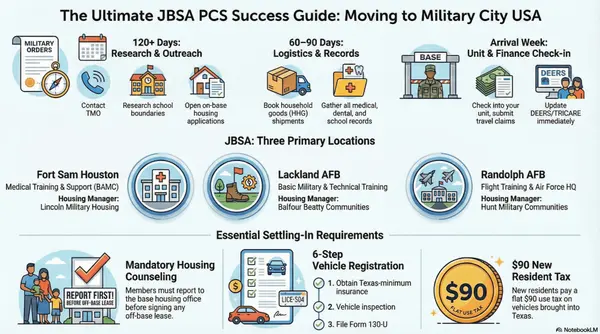
For buyers headed to JBSA Lackland, Randolph, Fort Sam Houston or another San Antonio-area assignment, starting early can make the process much easier.
We'll have an entire series dedicated specifically to PCS buyers later in this blog library.
The Best Time to Start Is Before You Need the House
You don't need to be ready to make an offer tomorrow before contacting a Realtor.
Actually, I'd rather hear from you too early than too late.
If you're ready?
We go.
If you're not?
We create a plan.
That's much better than discovering something 30 days before your lease ends that could have been addressed six months earlier.
When Does Your Lease End?
If you're thinking about buying a home around San Antonio, here's all I need to start:
1. When does your lease end?
2. What are you currently paying in rent?
3. Where would you like to live?
4. Have you talked with a lender yet?
That's enough to begin the conversation.
🔑 Text KEY to 726.224.4727
Tell me:
“My lease ends in ______.”
We'll work backward from there and start building your home-buying timeline.
Follow @jaylopezrealtor for San Antonio homes, new construction, VA information, first-time buyer education and real estate tips.
Buy a damn house.
Categories
Recent Posts