
Beyond the Orders: 5 Impactful Realities of Moving to Military City USA (JBSA)
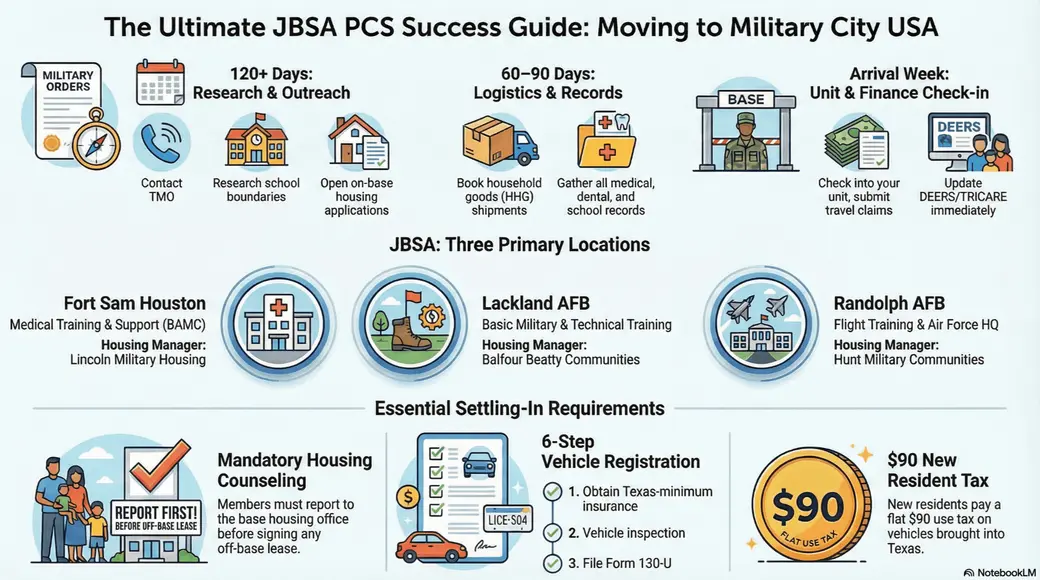
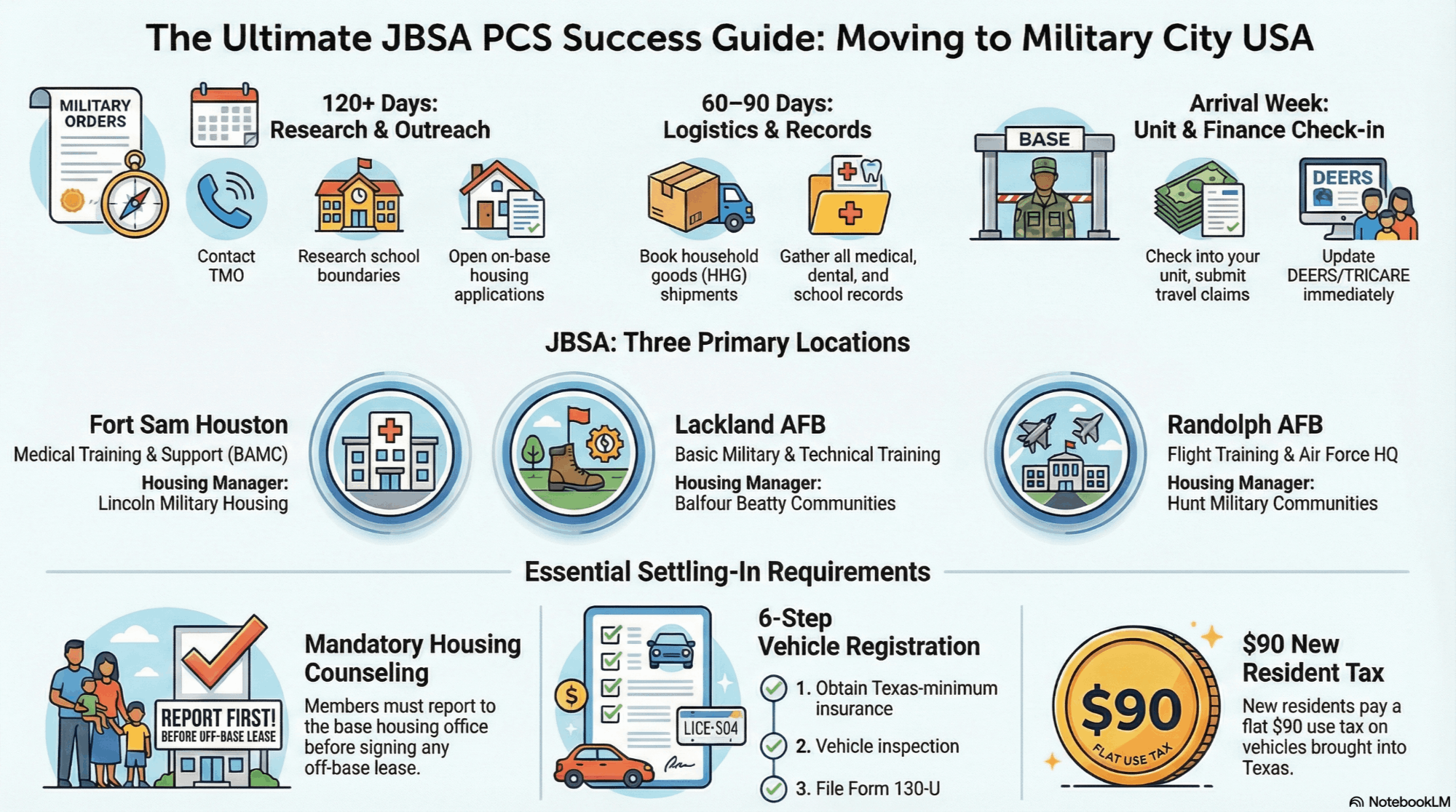 Transitioning to San Antonio—famously known as "Military City USA"—is more than just a typical PCS; it is an entry into one of the most robust military ecosystems in the world. Joint Base San Antonio (JBSA) is a sprawling, 67-square-mile enterprise that bridges three distinct installations: the historic, medical-centric Fort Sam Houston; the sprawling training hub of Lackland; and the prestigious, flight-heavy Randolph.
Juggling orders while navigating a city of nearly two million people can be a logistical puzzle. Between identifying the right neighborhood and deciphering base-specific regulations, the "standard" briefing often leaves out the high-impact nuances that define your quality of life. As you prepare to report, here are five essential realities—and professional "hacks"—for mastering your move to the heart of South Texas.
1. The "On-Base" School Paradox
One of the most frequent points of confusion for incoming families involves the schools located physically on JBSA installations. Many families assume these are Department of Defense Education Activity (DoDEA) schools, similar to those found overseas.
In reality, the schools at Fort Sam Houston, Lackland, and Randolph are Independent School Districts (ISDs) subject to the Texas Education Agency. Because these districts sit on land exempt from property taxation, they have no traditional taxable base. Instead, they rely entirely on state foundation funding and federal Impact Aid. This funding model makes resident status an absolute "red line" for enrollment.
The Residency Reality:
- The Enrollment Trigger: An "automatic right" to attend is reserved exclusively for students whose parents physically reside in on-base housing. Simply having orders to a JBSA unit does not grant you access.
- The Transfer Route: If you live off-base, you may apply for a "transfer waiver." Fort Sam Houston and Randolph Field ISDs accept applications for grades K-12, but Lackland ISD is restricted to grades 9-12 only.
- The Alternative: If you choose the "commuter life" off-installation, you will be moving into one of the 23 other Independent School Districts in the San Antonio area.
"Fort Sam Houston ISD, Lackland ISD or Randolph Field ISD are not part of the Department of Defense school system, they are independent school districts subject to the jurisdiction of the Texas Education Agency."
Consultant’s Tip: Do not assume "Orders to JBSA" equals "Access to Base Schools." If a specific installation school is your priority, your housing choice must be your first tactical move.
2. The High Stakes of the 15 MPH Rule
While every installation enforces speed limits, JBSA—particularly Lackland—maintains a rigid, zero-tolerance policy where penalties are automatic rather than discretionary. At JBSA, the Defense Biometric Identification System (DBIDS) is integrated with security protocols to ensure that violations carry immediate administrative weight.
The Penalty Matrix:
- 15 MPH Over: Result in an automatic 30-day suspension of base driving privileges.
- 20 MPH Over: Results in an automatic 60-day suspension.
In a 67-square-mile joint base environment, a suspension is a logistical nightmare. It isn't just a ban on driving to your office; it is a total prohibition from operating a vehicle anywhere on the installation. For a family living on base, this means losing the ability to drive to the Commissary, the Exchange, or the San Antonio Military Medical Center (SAMMC). In a city where life is car-dependent, these "automatic" penalties serve as a mandatory culture shock for those accustomed to more lenient posts.
3. The Spouse Career "Hack": Competitive Grants
The San Antonio job market is diverse, but breaking into entry-level roles in healthcare or IT often requires local certification. The Military Spouse Employment Grant Training Program, funded by the Air Force Aid Society (AFAS), is a powerful resource that many spouses overlook.
This program offers grants for short-term (3-6 week) certifications through local institutions, targeting high-demand fields like:
- Healthcare: Certified Nursing Assistant (CNA) and Medical Coding.
- Technology: CompTIA IT Fundamentals (ITF+), A+, and Security+.
- Wellness: Fitness Trainer certifications.
"This program offers free training and certification opportunities for active duty Air Force and Space Force spouses to help with entry-level employment skills and enhance the military spouses' employment opportunities."
Consultant’s Reality Check: While these grants are an incredible "hack," they are highly competitive and subject to seasonal funding. As of the current cycle, offerings may be limited or closed, but this should be the very first question your spouse asks at the Military and Family Readiness Center (M&FRC) upon arrival.
4. The $90 "New Resident" Vehicle Advantage
Texas is famously military-friendly, and nowhere is this more evident than at the county tax assessor’s office. While the standard Texas sales tax on a vehicle is 6.25%, military members moving into the state are eligible for a significantly lower flat rate.
The "Military Win" by the Numbers: For a $40,000 vehicle brought from out-of-state:
- Standard Resident Tax (6.25%): $2,500
- Military "New Resident Tax": $90
The Technical Advantage (The VIN Hack): Standard registration requires a VIN verification at a state-appointed station. However, the Source Context provides a specific exception: Military personnel are not required to complete a Law Enforcement Identification Number Inspection (Form VTR-68-A). Instead, you can self-certify the VIN directly on your Application for Texas Title and/or Registration (Form 130-U). This saves you a time-consuming trip to a busy inspection station.
Requirement: To secure this $90 rate, you must file your application at the county tax office within 30 days of establishing residency or entry into Texas.
5. Living the "90% Life" in Military City USA
San Antonio remains a rare jewel among major American metros: an affordable city with a high-tier lifestyle. The cost-of-living index consistently hovers around 90, compared to the national average of 100. For military families, this 10% "savings" translates directly into more housing for your BAH and a higher quality of life.
The city’s diversified economy—built on national defense, healthcare, and financial services—creates distinct neighborhood "vibes" that cater to different life stages:
- Oak Park-Northwood: This area offers an upscale, established feel with prestigious reputations and access to top-tier schools like Alamo Heights ISD. It is the go-to for those seeking a "status" neighborhood that remains accessible.
- Government Hill: Located steps from Fort Sam Houston, this historic area is the definition of "urban investment." It is a historic gem that is rapidly gentrifying, making it a favorite for first-time buyers and those looking to maximize their VA loan on a property with high appreciation potential.
Whether you are looking for a Hill Country retreat or a historic urban loft, the San Antonio market allows military families to maximize their entitlements in ways that high-cost coastal bases simply cannot match.
Conclusion: Looking Toward the Horizon
Joint Base San Antonio is a massive initiative with over 211 missions and 80,000 employees. It is a community that supports more than 250,000 retirees, serving as the "Gateway to the Air Force" and the home of Army medicine.
As you navigate your move, remember that "Military City USA" is more than a duty station—it is a community designed to support your career and your family’s growth.
In a city that serves over 250,000 retirees and 80,000 employees, will your PCS to JBSA be just a move, or your opportunity to truly settle into the heart of Military City USA?
Categories
Recent Posts